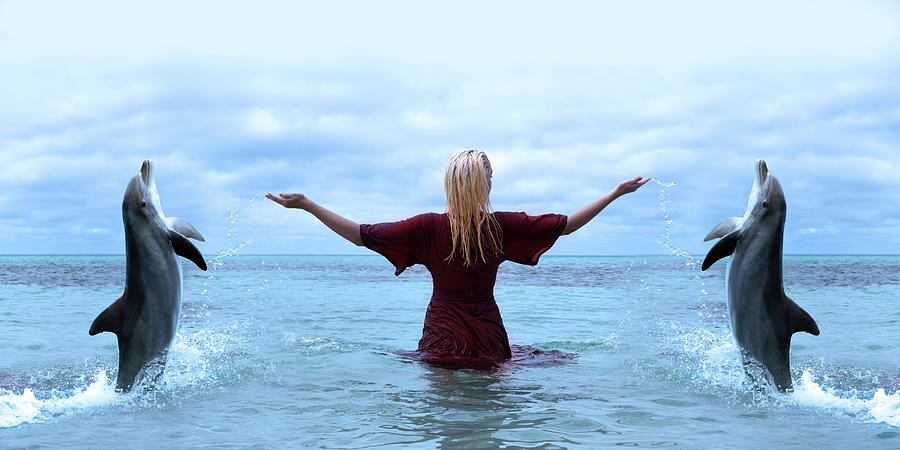
 Neptune rules over the sign of Pisces, the dreamiest fish in the zodiac, a creature preoccupied with the soul’s yearning. In Rome, it’s Poseidon — an aquatic deity with a temperament of the sea itself: at times tranquil, at others tempestuous and terrifying. But through the lens of astrology, Neptune becomes something altogether more nebulous — the ruler of illusions, imagination, addiction, transcendence, and dreams. Water is the most ancient of elements, it reflects our emotional realm. It’s both the tear in the eye and the wave in the womb — for what is the ocean if not the memory of everything we’ve forgotten? Neptune calls to us in visions, in songs that make no sense and yet move us to tears. It governs mystery and spiritual longing. But beware! For the same seas that cradle you can also drown you. Illusion can masquerade as insight. The spiritual high can slide into the psychic abyss.
Neptune is the part of us that knows without knowing. It is the archetype of the mystic and the addict alike — the soul that yearns to dissolve, to merge with something greater, to escape the jagged edges of reality. But through Neptune, we are also remember: we are all drops of the same ocean.
Neptune rules the great unconscious ocean lapping at the edges of your being. The emotional waters from which all form arises and into which all things dissolve. It’s the god who melts boundaries, who stirs confusion, who asks the question: What if this — all this — isn’t quite real? In the mythologies of old, Neptune wields a trident as a symbol of depth. Three prongs piercing through the surface, slicing through the superficial to reach the ancient knowing that lives far beneath our rational mind. When it’s active in your chart, it doesn’t speak in logic; it communicates in dreams, symbols, synchronicities, and drowns you in longing for something you can’t name — something eternal, exquisite, and frustratingly out of reach. People often talk about Neptune in terms of illusion — the patron saint of confusion, of spiritual bypassing, of falling madly in love with people you’ve projected your entire unmet childhood onto. But to reduce Neptune to illusion alone is like saying the ocean is just wet. Neptune offers a kind of forgetting — it can be forgetting as negligence, but in a higher state it is forgetting as transcendence. It lets you forget who you think you are so you can remember who you really are. Not a name, not a job title, not a tax bracket, but a soul, a wave on the infinite ocean.
Pisces, its vessel, absorbs the moods of the world like a sponge in a rainstorm. It feels everything, its own pain, yours, and the universe’s too. This is why Pisces and Neptune are so often associated with art, music, film — languages that exist beneath language, bypassing the brain and speaking directly to the soul’s ribcage. Art is Neptune’s church— these are all attempts to describe what cannot be described, to bottle the unbottleable.
When the world becomes too harsh, Neptune offers escape. In romance, in substances, in delusions or self-destruction dressed up as devotion. Who among us hasn’t at some point accepted the invitation to drift away, to numb, to disappear into fantasy when reality became unbearable? Yet, even in the delusion, there’s something more. Neptune doesn’t ask us to reject reality — it asks us to expand it. To see the otherworldly in the mundane, to recognize how the tides also stirs the soul. It isn’t interested in fact; it’s a lover of feeling. Where Saturn builds walls, Neptune dissolves them. Where Mars demands action, Neptune demands surrender.
So what do you do with Neptune? You don’t control it. You commune with it. You learn to float. You make art because your soul can’t not create. You pray to remember you were never lost. Most importantly, you learn to feel everything deeply, but not drown in it.
The ocean, in Jung’s mythology, becomes more than a vast and salty expanse. It is a mirror of the collective unconscious — the deep underlayer of the mind where ancestral memories, archetypes, instincts, and dreams swim like sea creatures. It’s the inherited mythos of all humanity. This part of you remembers things you’ve never been told, it resonates with a story you’ve never read, it fears the dark because of what it represents.
Now, the collective unconscious isn’t filed away in neat little folders like a psychological filing cabinet. It oozes and ebbs, and much like the literal ocean, it washes over the shores of consciousness in mysterious, often inconvenient ways. Through dreams, symbols, irrational longings — and perhaps most poignantly, through art. Art is the language of the deeper self. It bypasses the watchful ego — and it speaks straight to the archetypal soul. This is why trends in fashion or music are symptoms. Expressions. Surface ripples caused by shifts in the collective sea bed.
When a certain color palette sweeps through the fashion world, or a type of song — melancholic, hopeful, angry — dominates the charts, or a film captures the imagination of millions, it’s often because it’s expressing something we all feel but haven’t yet articulated. These forms rise from the deep and cling to the visible world, and we recognize them with feeling. We say, this song gets me. Or this image speaks to something I can’t quite name. It’s Neptune’s work, again. The great mystic with its sea of symbolism. It rules the collective mood. It shapes the zeitgeist through subtle, almost invisible infiltration. It sneaks into our souls through the side door. And we, in our quieter moments, tune into this frequency — when we write poems we don’t understand, when we cry during films we pretend we’re too cool for, when we dress in ways that speak louder than our words. We’re expressing ourselves, but we’re also channeling the us-ness of all of us. The vast, unseen consensus of human emotion moving like a current beneath our individual lives. The inner self becomes a tuning fork for these unseen frequencies. The more familiar you are with your own emotional tides, the more attuned you are to the great emotional ocean. You begin to feel what’s coming before it arrives, to intuit the mood of the world before it’s announced. Not because you’re psychic (although who’s to say?), but because you are part of the world, dreaming its dream.
In the end, to live deeply is to be part seer, reading the waves of the collective soul as they crash into the shores of our daily lives. To create, or even to feel, is to cast a line down into the infinite ocean and hope that what you pull up, however slippery or strange, brings a bit more light into the world above.
“Three quarters of the earth’s surface is submerged in water. This should give you some idea of how vast your psychic life is. When you think of all the sea creatures that scientists are still discovering – the giant squids (long thought extinct), resurfaced alive and well then you’ll begin to grasp how mysterious your unconscious truly is. People often think of the unconscious in terms of feelings, dreams and memories. But that would be like equating the ocean with what we see on the seashore. The unconscious, like the ocean, slides out past the shoals and rocks and down into a murky realm that has nothing to do with the world we live in. Your inner life is a barely tapped resource.” By Christopher Renstrom, Ruling Planets
Neptune rules more than escapism, fantasy, or art. What it truly offers is something far more profound, and perhaps even terrifying in its beauty: the transcendence of self, the surrender of ego, the annihilation of separation. Where Saturn insists on form — brick by brick, time by tick — Neptune says, “But what if there were no form? What if there were only meaning?” It is the god of dreams because it draws us into the space where logic unravels and the soul begins to remember what it really is.
People with Neptune prominently in their natal charts often move through life with hypersensitivity, picking up the invisible signals of the collective. To the world, they may seem distracted, distant, lost in thought — and sometimes they are lost. They’re elsewhere. Their senses are heightened. Neptune gives these souls a kind of emotional synesthesia, where sound becomes feeling, color becomes memory, and intuition becomes knowing without reason. But this heightened state of perception doesn’t come without cost. The boundaries most people rely on to function — emotional fences, cognitive filters, the good old-fashioned “it’s your problem, not mine” — can be tragically thin in the Neptunian being. They are prone to absorbing the moods of rooms, the sadness of strangers, the hidden pain behind the eyes of the smiling. The dream state they live in isn’t always peaceful. Sometimes it’s chaotic. Sometimes it’s a nightmare.
For Neptune’s great mission is unity — to take us beyond duality, beyond division, and to show us that the separations we cling to are illusions. Your skin isn’t a wall, your name isn’t a prison, your pain isn’t just yours. In Neptune’s world, we are all ripples on the same sea. Its magic and madness comes from this realization. To live under Neptune’s rule is to seek the infinite in the ordinary, to fall in love with ghosts and songs and strangers you’ve never met. It is to chase the horizon as it beckons with the promise that somewhere beyond the line, you will remember who you are. When Neptune takes your hand and leads you further into this inner ocean — when you follow the light through your own subconscious depths — you may find that what you were seeking out there was always inside.
Neptune is the romantic exile in a world of tax returns, dull lighting, and lukewarm conversations about the weather. To be Neptunian is to carry within you another world — a realm with meaning and beauty. So when the soul is caged in the humdrum of modernity —it grieves. Neptune knows life is meant to be transcendent. Art, spirit, connection, ecstasy — these are necessities. To strip life of beauty, to reduce it to clock-punching and queue-standing, is like draining the sea and asking the fish to enjoy a nice stroll. It’s spiritually suffocating.
When Neptunian souls find themselves trapped in this drabness, something inside them starts to wail. Not audibly, perhaps, but it’s a psychic howl, a tidal pull toward anywhere but here. It’s when the yearnings arrive, those strange tides in the night. A longing for something else. Something elusive. Connection, purpose, passion. To feel alive, awake, touched by the divine. It can be a dangerous longing, this. Because in the absence of true beauty, false ecstasies step in — the escapisms, the addictions, the illusions. The Neptunian soul, starved of art, might turn to intoxication. If not drink, then fantasy. If not drugs, then distractions. It becomes desperate. Desperate to return to a world that feels something.
For this longing, though often misdirected, is a homesickness. It tells you when your life has become too small for your soul. It urges you to seek the enchanted, to create heaven where there is none. A Neptunian being isn’t built for banality. They are built to dream. To drift. To dissolve and reassemble in ever more luminous forms. When everyday life feels awful, it’s because their vision is vast, and the current cage simply doesn’t fit. Neptune isn’t here to drag you from reality. Its’s here to reveal that reality, in its deepest form, is already enchanted. But you must have the eyes to see it — or failing that, the courage to create it.
“Water is life’s matter and matrix, mother and medium. There is no life without water.” —Albert Szent-Györgyi