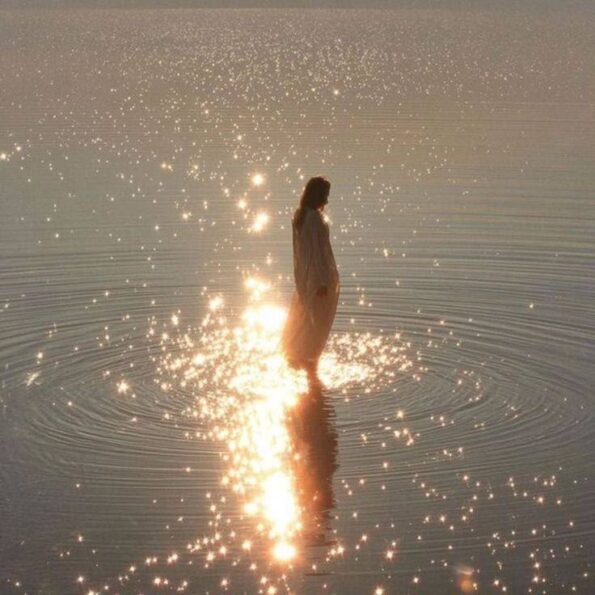
 In astrology, Neptune symbolizes a vague but persistent discomfort with ordinary life, there a sense of there being something missing even when we cannot name what it is. The feeling attached to no clear event. It enters with sadness and without an obvious cause. It comes with sudden spells of crying, wistfulness, fatigue with reality, or a longing we cannot quite define. We look around and some part of us is disappointed by existence itself. It is one of the more difficult Neptunian experiences to explain. The planet often works through what is beyond ordinary understanding. Saturnian pain usually has a shape. There is a limit, a failure, a responsibility, a loss, a concrete fact we can point toward. Neptune is more diffuse. We feel that the world isn’t what we hoped it would be. Ordinary life is too harsh, or just insufficient for whatever the soul seems to be asking for. It appears in very trivial moments. We cry while washing dishes, driving home, or hearing a piece of music. The trigger may be tiny, but the feeling underneath it is not. The ordinary moment is transparent enough so a much larger force leaks through. What often leaks through is grief, yearning, exhaustion, even beauty. We do not know.
Boundaries are important wherever Neptune is strong. In the area of life Neptune touches, we have difficulty distinguishing where we end and somebody else begins. We absorb moods. We sympathize easily. We imagine the other person’s suffering. We understand excuses. We feel guilty withdrawing. We worry that saying no will hurt somebody. We can confuse compassion with obligation. The emotional boundary between “I understand your pain” and “therefore I must solve your pain” is very thin. For people with a powerful Neptune in the natal chart, this needn’t be restricted to one particular area. It is a general way of moving through life. We feel other people strongly and then feel guilty for protecting ourselves from what we feel. Setting limits seems harsh because Neptune naturally wants union rather than separation. A boundary says, “This is yours and this is mine,” while Neptune replies, “But surely we are all one.” Beautiful in a monastery. More complicated when somebody wants to borrow money for the fifth time.
Neptunian people will often take a long time to understand the power of limits in their life. We may know intellectually – boundaries are healthy and still feel emotionally as if we are a terrible person the moment we enforce one. Somebody looks disappointed and then we want to reverse the decision. We eventually say no and then spend three hours wondering whether we were too mean. We decline a request and then offer six alternatives. We go out and establish a boundary and then personally escort the other person around it. The guilt is intense with Neptune. We don’t like causing pain, even when the pain is only another person’s disappointment at not getting what they wanted. Yet compassion without boundaries eventually turns into exhaustion, resentment, confusion, or self-erasure. We cannot be permanently available to everybody’s needs and still have a coherent life of our own. Healthy Neptune therefore need what initially feels rather un-Neptunian: definition. We need to be able to say, “I care about you and I am still not doing this.” We need to tolerate another person’s sadness without turning it into an instruction. It is spiritually offensive to the very Neptunian person at first. They think love should be unconditional, limitless, forgiving, and endlessly receptive.
The imagination is another major Neptunian realm. We often link fantasy with obviously dreamy people: the person who imagines the perfect romance, the aspiring novelist who rehearses receiving an award, the teenager picturing themselves as a movie star, musician, artist, famous writer, or some radiant future version of themselves. These fantasies are valuable, and they offer emotional release, inspiration, hope, and a temporary expansion beyond the limits of present circumstances. We can step out of the life we currently inhabit and enter one that feels more beautiful. For a little while, the limitations disappear. We are loved properly. We say the perfect thing. We are successful. We move somewhere wonderful. The ending changes. None of this is childish or unhealthy. Imagination is one of the psyche’s great forms of mercy. Reality gives us one version of events, while imagination allows us to experience alternatives. We replay what we wish had happened. We edit the scene. We give ourselves the answer we never received. We imagine the conversation going differently. We create a private film in which some unfinished emotional experience finally reaches the ending we wanted. It is restorative. The mind says, “Reality did not give us this, so let us visit it here for a moment.” For some, it is healing.
But fantasy is broader than romantic daydreaming or artistic visions. Some people insist they have no imagination if they don’t spend their afternoons picturing themselves on a yacht with a famous lover while receiving international awards. Then they spend four hours imagining every possible disaster coming up in the imaginary future. It is imagination too. Neptune makes gorgeous movies. It also directs horror. But the fears are Neptunian rather than Plutonian, so we don’t get the two confused. Pluto horror is more about threat, violation, death, power, taboo, the predator in the basement. Neptune horror is foggier: dread without a clear source, imagined catastrophe, losing our bearings, not knowing what is real, sensing something is wrong but being unable to locate it. Neptunian fear is rarely the terror of a concrete enemy. This territory is much more Plutonian. Neptune’s darker imagination is less defined and therefore, in its own way, more difficult to grasp. It’s more Neptune’s dreamy side turned into a nightmare. Neptune is overwhelmed by the sheer number of possibilities and feels there is nothing solid enough to fight. We may drift into helplessness before anything has actually happened.
The Neptunian imagination has sufficient power to ease pain, beautify suffering, transform disappointment, and temporarily suspend the unbearable. Art does exactly this. Music does it. Film does it. Poetry does it. Spirituality can do it. Love can do it. We take something painful and place it inside a larger symbolic world where until it is survivable. But Neptune works best when imagination is a window rather than the entire building. We can fantasize about the life we want and still return to the life that needs attending to today. We can then use imagination deliberately rather than being unknowingly governed by it.
Neptune feelings are enormous. Sympathy, love, grief, longing, beauty, suffering, pity, devotion and disappointment are all magnified. The planet also dislikes emotional edges. We feel sorry for somebody, and then we imagine their whole suffering. We fall in love, and then we fall in love with the person, their wounds, their possibilities, what they might become, what we might become beside them, and the entire invisible world seemingly surrounding the relationship. A song opens a door somewhere. A sad story can stay with us for days. Somebody else’s pain feels like our own. It is the sensitivity of this planet. It raises an important question: where does the flight of imagination end? We can ask this in the area of life occupied by Neptune in the natal chart, and more broadly in the lives of people who are strongly Neptunian. At what point does the wonderful ability to imagine possibilities replace our ability to live with what is actually here?
Most people with strong Neptune don’t lose their sense of reality altogether. We still know the imagination is imagination. We have an interest in the external world, relationships, work, money, food, shelter, appointments and our place among other people. We may disappear into a fantasy for an afternoon and still remember to buy groceries. There remains a boundary, however elastic, between the inner world and the external one. The difficulty begins when our need for the ideal, the absolute or the unlimited is strong enough to override the ordinary checks usually keeping imagination connected to actuality. Neptune is seductive because imagination has no natural ceiling. Reality says this person has limitations; imagination says perhaps love will transform them. Reality says a dream requires ten years of work; imagination lets us experience the finished masterpiece tonight. Reality says this relationship is uncertain; imagination gives us the wedding, the house, the reconciliation, the spiritual significance and possibly the soundtrack before the second date. The imagined world is much more emotionally satisfying as it does not have to obey the same laws. In imagination, nobody has to be tired. Money does not run out. Bodies do not age. Artists are recognized. Lovers finally understand. The perfect words arrive at the perfect moment. Nobody ruins the atmosphere by asking who is going to clean the kitchen.
Neptune is attached to the unlimited. Actual life is saying, “This much, not everything.” Neptune asks why everything should not be possible. A longing for the absolute found in many Neptunians is not inherently foolish. In fact, it is responsible for some of our greatest creative and spiritual impulses. We need to be able to imagine what does not yet exist. Every work of art existed first in imagination. Every social improvement required somebody to envision conditions other than the ones already present. Every love affair involves some willingness to imagine an unseen future. Every creative life depends upon believing in possibilities before they have concrete form. We need visions of possibility. The trouble begins when we are primarily attached to possibility.
If our emotional investment is always in what could be, the concrete present loses its value. The actual partner is compared with the imagined partner. The actual career is compared with the fantasy of recognition. The ordinary creative practice is compared with the masterpiece already playing beautifully inside our head. The present is a waiting room for the life we believe ought eventually to arrive. Then we can lose the ability to inhabit the moment. We are always leaning toward somewhere else. Somebody else. Some future. Some ideal state. Some imagined version of ourselves in which everything finally feels complete. We aren’t abandoning life dramatically. We may just be emotionally absent from it. We perform today’s obligations while living psychologically in tomorrow’s possibility. And because Neptune is attracted to what is unlimited, ordinary necessities are insulting. We have this enormous vision, this immense feeling, this spiritual calling, this transcendent love – and somebody still expects us to pay the bill.
If we are too detached from the concrete, we can lose sight of what is actually necessary to make the dream real. It is one of the ironies of excessive Neptune: the imagination is so devoted to possibility, it prevents possibility from taking form. We dream of writing but do not write. We dream of art but do not practice. We dream of love but avoid the uncomfortable vulnerability of an actual relationship. We dream of another life while neglecting the small decisions through which another life would actually be built. Neptune brings the image. But we have to build the bridge. It is where Saturn enters. Saturn can look like Neptune’s enemy. Saturn constantly introduces what Neptune would prefer to dissolve: limits, definitions, responsibilities, schedules, laws, consequences, distinctions and necessities. Neptune says, “Imagine everything.” Saturn says, “Wonderful. What exactly are you doing next week?” It is terribly unromantic. It is also indispensable.
Saturn gives form to what Neptune imagines. Saturn asks which possibilities are actually sustainable, which sacrifices we can afford, what resources are available, how much time it will require and where our responsibility begins and ends. Saturn gives Neptune somewhere to land. It is the apparent nemesis but also Neptune’s greatest ally. It protects us from floundering among endless possibilities. Neptune can imagine a hundred beautiful lives simultaneously. Saturn asks which one we are actually going to live. Without some Saturnian principle, every possibility is equally seductive. At the opposite extreme, however, we can have too little access to Neptune. Some people distrust imagination itself. If it cannot be seen, measured, demonstrated, purchased, scheduled or made immediately useful, they are suspicious of it. They may consider fantasy childish, romance embarrassing, spirituality foolish, dreams impractical and artistic longing self-indulgent. It looks sensible from the outside. At times, it is. But it is also fear as well.
The strongly Saturnian person may restrict their life. Restriction is safer than being swept away by anything they cannot control. Possibility itself is threatening. Possibility asks us to move beyond what has already been proven. Better the familiar disappointment than an uncertain dream. Saturnians are very mistrustful of being swept away. They watch a romantic film and identify the logistical problems. The lovers reunite dramatically in the rain and Saturn is wondering whether anybody has discussed their attachment styles, employment prospects or the likely cost of maintaining two residences. The happy ending comes. Saturn asks what happens Monday morning. There is wisdom in this. There is also the possibility of missing the movie. At the extreme Saturnian end, romantic clichés, fairy-tale endings and impossible love stories almost hurt. The internal reality checker refuses to suspend itself long enough to enter them. We think, “People don’t behave like that. Love can’t solve everything. They will probably be divorced in eighteen months.” Possibly true. Deeply awkward during Cinderella.
The Neptunian viewer may be crying before the orchestra has finished the final chord. They know perfectly well that real life is messier, but for two hours they are willing to inhabit the dream. They allow the symbolic world to carry them somewhere beyond ordinary probability. We need to be carried away sometimes. Without enough Neptune, we risk getting too narrow, cynical or mean-spirited if we cannot imagine anything beyond what already exists. We see only the disappointing person in front of us and never the potential for growth. We see only present circumstances and cannot imagine change. We see only practical usefulness and overlook beauty, compassion, mystery or symbolic meaning. A world governed entirely by Saturn would be highly organized. But if we looked only at what already existed, nothing new could emerge. But Neptune without Saturn is lost in what might exist, while Saturn without Neptune is imprisoned by what already does. We need both.
Saturn and Neptune seem antagonistic. One builds walls while the other dissolves them, but psychologically they correct one another. Saturn says there are limits. Neptune says limits aren’t the whole story. Saturn says this is what exists. Neptune says imagine what else might exist. Saturn asks what is necessary. Neptune asks what is meaningful. The Neptunian dream needs enough Saturn to survive contact with the world. The Saturnian reality needs enough Neptune to remain worth living in. Too much Neptune and we may spend our lives waiting for a life that exists beautifully only in imagination. Too much Saturn and we may successfully build a life we never once dreamed of wanting. The art lies somewhere between them: allowing ourselves to be swept away without being permanently lost, and accepting limits without mistaking them for the boundaries of what can ever be imagined.