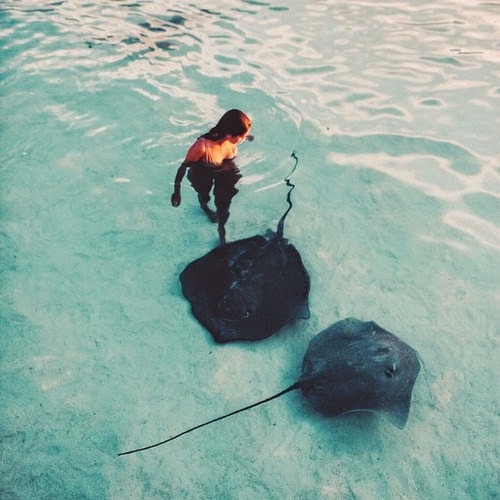
 Neptune will re-enter Pisces in 2012 and we will see this gorgeous oceanic planet affect mundane events, as well as via fashion, cinema and music. During its transit of its own sign of the fishes, we are interested in the world that was before birth and the one we shall see after death. We desire to understand the big picture, but there is an insurmountable chasm between our physical and spiritual selves. The astrological fishes stand for this dichotomy, representing both the yearning for spirit and the ravenous appetite of the physical body. It’s a planetary mood swing writ large across the collective soul.
Neptune in Pisces is the universe’s favorite opium dream, a misty, romantic longing to return to something we can’t quite name but have always known. It’s akin to trying to remember a dream you’re still dreaming. This era, from 2012 until 2026, is no mere astrological gimmick, it’s a deep dive into the subconscious lagoon of the collective psyche. Think of Pisces as two fish swimming in opposite directions, tied by an invisible thread, one striving for transcendence, the other craving earthly intoxication. During this transit, art gets dreamier. Music, cinema, and fashion shimmer with a Neptunian glaze, think of the rise of vaporwave, the dominance of Lana Del Rey, the moody magic of “Moonlight” winning Best Picture. Spirituality becomes aesthetic. A crystal in one hand, a cocktail in the other. We crave connection but fear the loss of self that comes with it.
Neptune also casts glamour, illusion, and delusion. It tells us the void can be filled – with love, with fame, with substances, with scrolling. There’s a cost to this dream-state. Many of us have wandered too far from our own center in search of meaning. We are spirit wearing skin, memory housed in meat. We want the eternity of the stars and the sweetness of the kiss. We crave to transcend the ego while simultaneously refreshing the selfie. Those born under the Piscean Sun feel this most acutely, because they embody the liminality that most of us only touch in dreams. They live with one foot in a world we can’t name, and another in a world that won’t stop shouting. This Neptune transit asks us to surrender in devotion. To let go of the need to know, to control, to fix. To allow love without ownership, faith without proof, beauty without reason. It is, in the end, a tide. And the best thing to do with a tide is to float. To let it carry you somewhere unexpected.
When we speak of Neptune, particularly in Pisces, we’re invoking the longing of the soul to remember something it never learned, and the ache to return to a place it can’t describe. Neptune governs the veil between realities – the psychic, the spiritual, the ineffable. It is the planet of dreams, illusions, transcendence, and exquisite melancholy. It rules what we feel when a certain scent, a fragment of a song, or a stranger’s eyes suddenly cracks open a door inside us. A door to… what? We don’t know. But Neptune tells us, “You’ve been here before, haven’t you?” And part of us nods, tears rising, without ever knowing why. Birth, in the Neptunian sense, is a forgetting. A submersion into this physical plane where, in the great irony of existence, we spend our lives trying to remember the thing we were forced to forget.
It’s as though we arrived in this world carrying the perfume of another, a fragrance fading with each passing year. Some Neptunian souls can still catch its trace, though – it lingers in dreams, in déjà vu, in the sense that life isn’t as solid as it pretends to be. And they live with this contradiction: knowing deeply something else exists, yet unable to grasp it fully. It’s like being haunted by beauty. This is why Pisces, ruled by Neptune, is the end of the zodiacal cycle – a dissolution. It’s the letting go, the return to source, the final surrender of ego. And as such, it carries an enormous psychic weight. Pisces doesn’t need to be taught that the world is a place of suffering and redemption, it already knows. It doesn’t need proof of other realities, it walks between them, often overwhelmed by their pull.
Neptune is difficult for astrologers. It doesn’t speak in a language we can easily interpret. It doesn’t do cause-and-effect. Neptune is more like a dream you forgot upon waking. Profound, but intangible. And in a culture obsessed with results, Neptune’s subtlety is almost an affront. It eludes definition deliberately, seductively. But we feel it, don’t we? The urge to plunge into the mystical, the symbolic, the soulful – to understand who we were before we were named, before we were burdened with identity. The ocean, Neptune’s mirror, shows us how to be infinite and formless. It teaches surrender, which is not the same as submission, it is the art of softening into something bigger than oneself.
When we explore Neptune, we’re attempting, in our clumsy, glorious human way, to reconnect with the divine mystery. To heal the fracture between what is and what might have been. To feed the fishes within us, the hungry ones swimming between what is real and what is remembered. And so we are drawn to the Neptunian places: temples, oceans, ashrams, art studios, bedrooms at 2am. For communion. For the chance to lose ourselves, just for a moment, in something that says: you are not alone, you have always been part of something more. And perhaps that’s enough – not to know, but to feel. Not to solve Neptune, but to let it wash over us, again and again, until we remember how to swim in both worlds.
When Neptune was discovered in the mid-19th century, it felt as though humanity collectively turned its ear toward the beyond, asking, “Is anyone there?” This was the age of the séance, of ectoplasm and flickering gaslight, of parlor rooms where veils were thin and the yearning for transcendence was palpable. It’s no accident Neptune’s discovery coincided with a cultural blossoming of spiritualism – as a lived experience. People wanted to believe death wasn’t the end. It was a comfort to know the soul persisted, and love could still be reached across the great divide. And Neptune, ever the illusionist, didn’t so much offer proof as possibility.
This is the thing about Neptune, it doesn’t give answers; it gives atmosphere. It doesn’t lead you to the truth in a straight line, but seduces you into feeling your way to it. When Neptune transits, we become more porous. The walls between us and the unseen grow thinner. The rational mind softens, giving way to the intuitive, the imaginal, the irrational in the most wonderful sense. Dreams intensify, synchronicities spike, and we find ourselves oddly drawn to the mystical, the tragic, the beautifully broken. Reality becomes slightly transparent, and through it, we glimpse… something else. Something beyond.
In Pisces, its home sign, Neptune is at its most powerful, but also at its most indulgent. It bathes the world in an emotional and creative saturation. It’s also a profoundly feminine energy in the archetypal sense. Neptune leads us to the inner waters, the lunar tides, the intuitive knowing that can’t be measured or marketed. The Feminine Mystique is a reawakening of what the rational world has long tried to suppress: softness, mystery, empathy, interconnectedness. Neptune is the ocean of the soul, and we are all invited to wade in, whether we write novels or simply dream vividly on Tuesday nights. Each generation, marked by Neptune’s slow, sweeping movement, carries its own holy longing. In Sagittarius, it searched for truth in far-off lands and philosophies. In Capricorn, it tried to spiritualize form, or at least find meaning in the hustle. In Pisces, we are swimming toward union. Toward remembering how beauty matters, how love heals, how art can save lives in ways science will never quite understand.
But Neptune also asks us to be honest about our blind spots. It shows us where we suffer unnecessarily, where we remain in toxic patterns because we believe they are romantic, or numbing routines because they feel safe. It offers escapism, but also redemption, if we are willing to feel the ache fully, to see where the illusion ends and the healing begins.
Neptune, particularly in its Piscean home, asks us to feel. To dissolve into the sea. The Sun was square Neptune in the case of Carl Jung. Here we see a life lived in the conflict between the ego and Neptune’s hunger for mystery. Jung’s very existence was a love letter to the Neptunian realm: the archetypes, the shadows, the dreamscapes where the unconscious speaks in symbols and strange synchronies. He wandered willingly into the caves of the self seeking communion. He didn’t want to dominate the mind, he wanted to understand its layers. As a dual sign, Pisces embodies paradox: life and death, beginning and end, body and soul. It is mutable, which means it adapts through intuition. It is feminine, in the archetypal sense of receptivity and flow. And it is of the night – the fertile, dreaming dark, where stars are born and secrets are kept.
And Pisces? Pisces is the current that carries us there. Quietly, gently, inevitably.
Neptune, the ruler of Pisces, is associated positively with mysticism and self-sacrifice. The negative aspect of Pisces is associated with lack of boundaries, illusions, addictions and delusions…Psychologically speaking Pisces is also associated with the unconscious, as is its natural Twelfth House. Pisces is water in its oceanic dimension, and you cannot see the bottom of it. People born under the sign are quite comfortable floating in a boundless way. They are not threatened by chaos. The Heavens Declare: Astrological Ages and the Evolution of Consciousness
