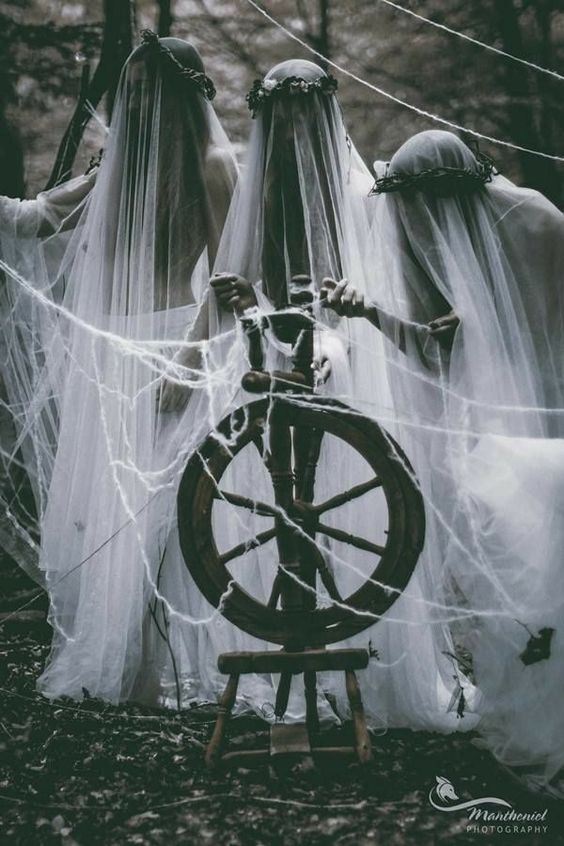
 Happy Halloween, dear creatures of shadow and sugar. As we step into Scorpio’s territory, the air seems to thicken with mystery. This is the season of masks, candlelight, costumes, haunted laughter, and the strange human pleasure of pretending to be what we secretly fear, desire, or recognize in ourselves. Halloween gives us permission to flirt with darkness without having to marry it. We dress as ghosts, monsters, witches, vampires, devils, and other socially unacceptable parts of the psyche, then politely ask strangers for candy. Humanity is absurd, but occasionally in a spiritually useful way. Beneath the playful mischief of Halloween, there is something older and more serious moving through the atmosphere. The costumes and disguises tells us how identity itself is a mask, life is full of hidden layers, and the visible world is never the whole story. Scorpio understands this instinctively. Scorpio knows that beneath charm there may be hunger, beneath control there may be fear, beneath desire there may be grief, and beneath every bright little human entity there is mortality tapping its foot in the corner, waiting to be acknowledged.
Moirai, the Greek Fates, can enter the imagination so powerfully at this time. They represent the mysterious force of destiny, the thread of life spun, measured, and eventually cut. Life isn’t entirely ours to command. We can choose, struggle, love, resist, transform, and make a dramatic mess of things in several creative directions, but there are deeper patterns at work too. Fate moves with an ancient impartiality, blind because it refuses to negotiate with ego. There is something deeply Scorpionic in this. Scorpio wants the root, the wound, the secret, the inheritance, the desire, the death before the rebirth. Also, transformation is rarely cute. It is descent. It is confrontation. It is meeting the forces that strip away illusion and force us to see what has power over us. The Moirai belong to this same symbolic realm: the place where human will meets something larger, darker, and less impressed by our plans.
Their connection to the underworld is about inevitability. Pluto, ruler of the underworld and modern ruler of Scorpio, governs the forces we cannot avoid forever: loss, desire, power, endings, obsession, survival, and transformation. The Moirai mirror this same truth. Life is threaded with mystery, and some things arrive because they belong to the deeper layer of the soul. A cheerful thought for Halloween, obviously. Nothing says festive like destiny with scissors.
Halloween can feel so strangely liberating. For one night, we admit what ordinary life avoids. We acknowledge the dead, the monstrous, the hidden, the forbidden. We laugh at fear. We dance with shadows. We put on masks. The witch, the ghost, the vampire, the skeleton – each one carries a piece of the psyche we usually keep locked away. So as Halloween unfolds, beneath the costumes and candy and theatrical terror, there is an invitation to remember the deeper forces at play. Fate, death, transformation, desire, shadow, and rebirth are life, only wearing darker clothing. Scorpio season asks us not to turn away from these mysteries, but to meet them with courage, curiosity, and maybe a slightly wicked smile.
The presence of Moira (Scorpio and Pluto ruled) evokes both awe and dread, because fate is arrives with the authority of something older than choice, older than personality, older than the comforting illusion we are fully in charge of our own story. Moira represents the force ushering in the unthinkable and unexpected into human life: this meeting changes everything, its a loss rearranging the soul, an ending no one was ready for, it is the birth beginning a new thread before anyone understands what it will ask of them. Fate feels immense. It has the emotional subtlety of the ocean. Beautiful. Also fully capable of swallowing your plans whole life.
In Greek mythology, the Moirai are the three goddesses of fate, often imagined as three sisters whose work governs the entire arc of mortal existence. Clotho spins the thread of life, beginning the pattern before the individual has a name. Lachesis measures the thread, determining its length, shape, and unfolding, the span of years and the major turns of the road. Atropos cuts the thread, bringing the story to its necessary end. Together, they form a vision of life that is both terrifying and strangely elegant: birth, duration, and death held in one continuous movement, as if every existence were a thread drawn from the unseen, stretched across time, and finally returned to mystery.
There is something humbling in the image of these three figures. They do not rage. They do not negotiate. They do not explain themselves in a way to make us feel emotionally included. Their power is blind and automatic. It operates beyond preference. Fate is impartial. It doesn’t pause to consider whether we feel ready, whether we have achieved closure, whether our vision had quite a different plan. The Moirai represent necessity itself: the deep law woven beneath the surface of life, the pattern that continues whether we approve of it or not. This presence carries such Scorpionic weight. Scorpio knows that underneath the visible world move older forces: desire, loss, inheritance, death, transformation, power, obsession, survival, and rebirth. The Moirai belong to this same underworld intelligence. Life is shaped from below by necessity. We may choose how to respond, how to love, how to endure, how to transform, but we do not choose every thread placed in our hands. Some things are given. Some things are taken. Some things arrive like a door opening in the dark.
Moira is the larger principle of fate. It paints a vivid portrait of the forces shaping existence. Necessity and destiny are woven into her being. She is the pattern beneath the pattern, the hand behind the veil, the quiet reckoning of becoming. Human life is bound together by more than personal intention. We are connected by timing, ancestry, consequence, mortality, and the mysterious crossings of live making one person’s fate inseparable from another’s. No thread exists completely alone. Every life touches the loom. The Moirai were considered powerful beyond even the gods, which says something deeply uncomfortable and wonderfully dramatic about the Greek imagination. Even divine beings, with all their thunderbolts, seductions, grudges, and spectacular family dysfunction, weren’t entirely free from fate. This gives the Moirai an absolute power. The gods may rule domains, but the Moirai rule the conditions under which any domain can exist at all. Birth, life, and death are the frame of the human experience.
Yet, there is a strange mercy in this myth. If fate exists, then not everything is random. Not every wound is meaningless. Not every turn in the road is merely chaos. The Moirai suggest your life is threaded with pattern, even if this pattern often reveals itself with all the warmth of a locked basement. We may not understand why certain things happen, and pretending we do can become its own little spiritual hell. But the image of the thread gives human life a kind of solemn dignity. Each life is spun. Each life is measured. Each life is cut. Brief, fragile, maddening, luminous. A thread, but not nothing.
Moira confronts us with the limits of mortal existence. We don’t get endless time. We don’t get complete control. We don’t get to edit out death, loss, or consequence because they clash with our preferred aesthetic. The thread has a length, and none of us are handed the ruler. But this doesn’t make life empty. It makes it urgent. It makes love matter. It makes choices matter. It makes the small moments glow with a slightly unbearable beauty, because they are happening inside the measured thread, not outside it. The Moirai ask for acceptance. Fate should never become an excuse to become passive. Their myth doesn’t erase human agency; it places it inside a larger field. We may not control the spinning, measuring, or cutting, but we participate in how the thread is lived. We decide whether we meet necessity with bitterness or depth, whether loss hardens us or initiates us, whether the unknown makes us cruel or reverent. Fate may shape the container, but consciousness shapes the meaning we make within it.
From a Jungian point of view, fate is often the name we give to the parts of ourselves we haven’t yet met. It is the unconscious arriving. The neglected inner world finds doors, symbols, accidents, attractions, repetitions, crises, and relationships through which to announce itself. What we refuse to know inwardly has a habit of arranging itself outwardly. Life keeps sending us the same lesson in different shoes until we finally stop pretending we do not recognize it. Fate is psychologically fascinating. It can be the pressure of the unlived life. The abandoned desire. The disowned rage. The grief we buried because we had no language for it. The power we feared. The vulnerability we armored over. The truth we sensed but didn’t want to pay for. These things gather force in the underworld of the psyche, and eventually they return as circumstance. Suddenly we aren’t choosing freely so much as reenacting blindly. We call it destiny, but often it is the unconscious knocking.
Astrologically, Scorpio carries this same dark magnetism. Scorpio is averse to the cheerful little surface of life, where everyone pretends to be fine. Scorpio belongs to the hidden currents: desire, death, inheritance, obsession, power, trauma, intimacy, survival, and transformation. Life is shaped as much by what is buried as by what is declared. Pluto, its modern ruler, deepens this association with fate. It governs what lies beneath the visible order of things. It is the force stripping away illusion. It pulls us into confrontation, and reveals what has been controlling us from below.
In this sense, Scorpio and Pluto feel fated because they describe the places where life isn’t fully negotiable. We do not choose our deepest wounds in any simple way. We do not choose the patterns we inherit, the compulsions, the losses, or the desires. These forces move through us with a power larger than personal will. They expose the limits of the ego’s favorite fantasy: we are calmly steering our ships through rational waters. Scorpio laughs at this, probably in a dimly lit room. It knows there are oceans beneath the floorboards. The famous phrase “whatever will be, will be” captures one side of this mystery: the surrender to what cannot be controlled. There is wisdom in this surrender, especially for the parts of us believing life can be conquered by sufficient planning, charm, or color-coded anxiety. Some things will unfold no matter how tightly we grip the steering wheel. Certain meetings, endings, awakenings, and losses seem to arrive with the strange authority of necessity. They feel less like choices and more like thresholds. We cross them, or they cross us. Either way, something changes.
There may be patterns written into the stars, but there is also the matter of how we live them. A birth chart may describe tendencies, tensions, gifts, wounds, and archetypal pressures, but it does not excuse us from developing a spine, a conscience, and the occasional ability to make a decent decision before everything catches fire. “Written in the stars” is a beautiful phrase, it suggests our life has pattern. The heavens, in their vast and glittering indifference, may reflect something about the shape of the soul. But even here, the mystery deepens. Who writes? What writes? Is the chart a command, a mirror, a map, a spell, a law for the psyche? Astrology, at its best, would never reduce life to fatalism. It gives symbolic language to the forces moving through us. It says, “Here are the gods you are carrying. Here are the conflicts you may enact. What we do with this knowledge is where freedom begins to enter the room.
The intersection of astrology and psychology is compelling. Both are concerned with pattern. Both ask why certain themes repeat, why certain people magnetize us, why certain crises arrive at just the right moment to ruin our plans and reveal our souls. Jungian psychology speaks of the unconscious, archetypes, projection, shadow, individuation. Astrology speaks through planets, signs, houses, aspects, transits. Different languages, perhaps, but both point toward the same unnerving possibility: human life is shaped by forces larger than the conscious ego, and freedom is found by becoming conscious of them. Writers in psychological astrology have long explored this tension between fate and free will. The horoscope can feel like fate because it reveals patterns we didn’t choose and cannot simply remove. But it can also become an instrument of freedom because what is named can be worked with. A pattern seen clearly is no longer quite as blind. A compulsion understood is no longer quite as absolute. A wound brought into consciousness no longer has to keep disguising itself as destiny.
C.E.O. Carter’s reflected on fate and free will in the horoscope. He pointed toward this very problem: how much of life is given, and how much is shaped by response? The answer is probably not comforting enough for people who like clean categories. We are neither entirely free nor entirely bound. We are born into conditions, patterns, temperaments, inheritances, bodies, families, histories, and invisible psychic forces. But within those conditions, consciousness matters. Choice matters. Effort matters. The soul’s relationship to its own pattern matters enormously. Fate may provide the thread, but how we carry it, knot it, weave it, or keep tripping over it is partly our participation.
Scorpio won’t pretend fate doesn’t exist. Freedom comes through descent. Through facing the shadow. Through admitting what has power over us. Through seeing where we are possessed by desire, fear, grief, resentment, longing, or old survival mechanisms. Scorpio’s transformative power is often the hard, intimate work of reclaiming what has been unconscious, so that life is no longer lived as a series of mysterious ambushes from within. Perhaps fate and free will are not enemies after all. Perhaps fate is the material we are given, and free will is the consciousness we bring to it. Fate is the undercurrent, the inheritance, the archetypal pattern, the thread spun before we fully knew ourselves. Free will is the awakening within the pattern. It is the moment we realize, “I have been here before. I know this room. I know this wound. I know this temptation.” And then, instead of sleepwalking into the same old fire, we pause. We choose differently. Maybe not perfectly. Maybe not gracefully. But differently enough so the soul begins to change.
This is the mercy of fate: it may bind us until we become conscious, but consciousness changes our relationship to the binding. What once felt like doom can become initiation. What once repeated as compulsion can become wisdom. What once arrived as crisis can become transformation. The hidden forces shaping our lives are here to be faced, integrated, and ultimately lived with more honesty. The stars may incline, the unconscious may press, the Moirai may spin their threads, but the human being still has the terrible, beautiful responsibility of waking up inside the pattern and deciding how to meet it.
“I find that the only satisfying belief is that the environment is a reflection of the inner, either as it is or was, so that, though an aspect may seem foreign to our character and only appropriate to our external conditions, in reality both correspond. It is of course obvious that our characters may change much more quickly than our bodies and circumstances, so that the correspondence is seldom perfect or complete; but in a general sense the one follows the other. As within, so without…In judging these matters it is necessary to remember that we see but a part of each individual, and only a little even of ourselves. The great ocean of the unconscious underlies the conscious, as the visible iceberg is but a fraction of the whole. Astrologers, in seeking to understand the Law of expression, by which all human beings seek to express their own natures through all available channels. The work of the astrologer is to find beneficial and appropriate media through which the horoscopic forces can be expressed. These forces cannot be escaped, but they can be analyzed, understood, and directed.”

In both psychology and astrology, there is a quiet but powerful suspicion: the life we live on the surface is not the whole story. Beneath our conscious choices, opinions, plans, preferences, and impressive little acts of control, something deeper is always moving. The unconscious is alive, fluid, restless, symbolic, and endlessly creative. It dreams through us. It repeats through us. It arranges attractions, fears, crises, longings, and strange coincidences with the unsettling artistry of a playwright who refuses to explain the plot until Act Three. From this point of view, many events in life may be expressions of a hidden intelligence within the psyche, a deeper pattern trying to become conscious. The major events of our lives often gather around invisible themes. We meet the same emotional lesson in different people. We encounter the same wound in different faces. We find ourselves drawn toward situations exposing exactly what we would rather not see. Life seems to conspire to bring us into contact with the unlived and unintegrated parts of ourselves.
Astrology gives symbolic language to this mysterious unfolding. The transits of the planets describe timing, pressure, atmosphere, and archetypal activation. When a planet touches a sensitive point in the natal chart, something within the psyche stirs. A theme wakes up. A pattern asks to be lived, confronted, released, or transformed. The outer world often provides the stage, but the drama belongs to the soul.
The slower-moving planets are especially powerful in this sense because they rearrange us. Jupiter expands meaning, faith, possibility, and hunger for growth. Saturn confronts us with limits, time, consequence, and discipline. Uranus breaks open stale patterns, shocks us awake, and refuses to let the soul rot inside a life that has become too small. Neptune dissolves certainty, blurs boundaries, awakens longing, and invites us into mystery, compassion, confusion, and surrender. Pluto, darkest and most uncompromising of them all, drags us downward into the roots, where death, rebirth, power, compulsion, loss, survival, and transformation wait with terrible patience.
Yet the faster-moving planets matter too, because while fate seems to only arrive wearing a black cloak and announcing itself with thunder, sometimes it arrives through an ordinary conversation, a sudden irritation, a flirtation, a memory, a mood, a sentence overheard at the wrong or perfect time. The Sun, Moon, Mercury, Venus, and Mars activate our natal patterns constantly, triggering small encounters with ourselves throughout daily life. These are the little mirrors. The minor frictions. The passing emotional forces. The tiny openings where we can notice what we want, what we avoid, what we defend, what we project, what we keep repeating. The daily planets keep the psyche in motion.
Pluto, however, has a special relationship with fate because it belongs to the realm where conscious control begins to fail. It symbolizes the underworld of the psyche, the buried material. Pluto is where life strips away the decorative self and asks what is really there. It is the force confronting us with what cannot be negotiated away. Pluto has an association with death and rebirth. It can be literal. But it more often describes the deep psychic process of endings we cannot be reverse. An identity dies. A relationship dies. A fantasy dies. A way of surviving dies. A belief system collapses. The person we thought we were no longer fits, and no amount of positive thinking can zip the old costume back up. Pluto transits, when they visit, often feel fated because they bring us into contact with forces larger than preference. Something is taken, exposed, intensified, or transformed.
The discovery of Pluto in the early twentieth century resonates symbolically with the rise of depth psychology, with its descent into the unconscious, dreams, instincts, trauma, complexes, shadow, and hidden motivation. Whether one treats this as meaningful synchronicity or simply an elegant historical echo, the symbolism is striking. Pluto’s astrological meaning mirrors the psychological discovery: human beings aren’t transparent to themselves. We are haunted, driven, inherited, defended, and secretly loyal to things we may not even understand. The unconscious is beneath control.
Pluto’s position in the natal chart can show where a person encounters Moira, the face of fate, most intensely. In this area, life may feel charged, unavoidable, dangerous, magnetic, or transformative. There may be personal tragedies, losses, obsessions, inheritances, betrayals, compulsions, or confrontations with power. It can make the person feel as if something deeper than choice has entered the room. Pluto can bring disaster, but it most often brings seriousness. It marks the places where innocence is difficult to keep, where the soul must grow through contact with what is raw, final, and real.
People with strong Pluto signatures often seem to live closer to the edge of fate. They may test limits, court intensity, push boundaries, attract crises, or be drawn toward the forbidden, the hidden, the psychologically dangerous, and the emotionally volcanic. Sometimes they appear fearless, but often they are intimate with fear. They may feel ordinary life is too thin, too nice, too false, and so they seek the places where something deeper pulses beneath the floor. They want contact with the real. Pluto people often discover, one way or another, life is not transformed by staying clean and untouched. Transformation requires descent. Yet even the strongest Pluto person must eventually confront the ultimate boundary: mortality. No will is strong enough to bargain forever with the body. No intensity, no desire, no obsession, no power, no depth of insight can exempt us from the fact – incarnation has an ending.
This is the final teaching of Pluto and Moira alike. The thread is cut. The body returns. The form dissolves. All our ways of control, all our heroic resistance, all our secret attempts to outwit vulnerability eventually meet the same dark doorway.
Fate humbles us. It takes away the fantasy. But it also invites us into a deeper participation with life. If the unconscious shapes our circumstances, then becoming conscious changes our relationship to destiny. What is hidden rules us blindly. What is brought into awareness can be suffered, chosen, transformed, or released with greater dignity. We may not control the whole pattern, but we can learn how to meet it. We can stop sleepwalking through our compulsions and begin to recognize the myth we are living. The planets, the unconscious, Pluto, Moira, fate – all point toward the same unsettling realization: human life is shaped by forces both within and beyond us. We are not simply victims of these forces, but neither are we their masters. We are participants. We are threads in a vast and mysterious weaving, carrying old knots, psychic patterns, wounds, gifts, instincts, and longings, all seeking expression through our lives. Some events break us open. Some strip us bare. Some reveal the soul we were too defended to meet any other way.
The thread may be spun by mystery, measured by necessity, and eventually cut by time, but while it is in our hands, consciousness can still change everything.
Love is one of the few areas of life where even sensible people begin speaking strangely. We may claim to be rational, modern, emotionally literate adults, and then one person looks at us in a certain way and suddenly we are discussing destiny. Love has always felt fated. It seems to defy laws of choice. We do not calmly select the person who will awaken our longing, terror, devotion, jealousy, hunger, and unresolved childhood material. Love arrives, and suddenly the unconscious has taken off its coat and made itself comfortable. Within the archetypal realm of Scorpio, Pluto, and the 8th house, relationship is rarely simple companionship. It is initiation. It is the place where desire becomes a doorway, intimacy becomes a mirror, and attachment becomes an underworld descent. Here, love presses on the hidden places. It awakens what has been buried, intensifies what has been denied, and exposes the emotional bargains we made long before we knew we were making them. Pluto brings people together so something unconscious can be revealed, surrendered, burned, mourned, or reborn.
Love under Plutonian influence can feel so enormous. The emotions are less like little portions. They come in intense doses. Affection may become devotion. Desire may become obsession. Fear may become control. Vulnerability may become suspicion. Passion may become a fever, and hatred may sometimes sit disturbingly close to longing. Love, in this realm can be fierce, possessive, transformative, humiliating, ecstatic, terrifying, and strangely medicinal. It can make us feel more alive than anything else.
After certain encounters, we aren’t the same person who entered them. Something in us has died, or awakened, or been stripped of its lies. We may discover our capacity for surrender, our fear of abandonment, our need for control, our hunger for fusion, our secret power, our shame, our rage, our ability to trust, or our inability to trust. The relationship becomes a furnace. What is false burns first, though unfortunately what is false is often something we were very attached to and had given a charming nickname. This is where love begins to feel like fate. Not because every intense relationship is “meant to be” in the romantic sense, a phrase responsible for an impressive amount of emotional property damage, but because these encounters often seem to arrive with the force of necessity. They draw us toward what we must confront. The person may seem less like a random choice and more like a messenger from the unconscious, carrying exactly the wound, desire, shadow, or transformation we were not ready to meet directly. The feeling of destiny may come from the psyche recognizing itself in the other before the conscious mind has caught up. Something deep says, “There you are.”
Plutonian love often involves emotional entanglement. It touches the places where we are least detached. It activates survival instincts. It can awaken the fear of loss so sharply, love becomes less like an open hand and more like a locked room. The desire to merge may become the fear of being consumed. The desire to trust may awaken the terror of betrayal. The wish to be known may clash with the fear that being known will give someone power over us. This is the cruelty and gift of deep intimacy: it gives another person access to the parts of us we usually keep hidden behind competence, charm, irony, or whatever personality strategy has been keeping us emotionally employed.
There can be deep beauty in this. Pluto can deepen love beyond sentiment. It can create bonds of extraordinary loyalty, passion, honesty, and psychological depth. It can bring two people into one another, beyond the glossy advertisement of the self. Intimacy can survives the collapse of fantasy because it is rooted in something more enduring than idealization. But Pluto can also drag love into compulsion when consciousness is absent. It can turn attachment into possession, passion into domination, vulnerability into manipulation, and desire into a battlefield where both people are fighting ghosts while insisting they are fighting each other. Pluto and its aspects in the natal chart often show where we tempt fate, where we move toward intensity even when some part of us senses the danger. We don’t head out to consciously choose chaos while wearing dramatic eyeliner and whispering, “Ruin me.” More often, a deeper force is at work. The unconscious is attracted to situations promising transformation, even if the conscious personality would prefer a quiet life, stable sleep, and fewer spiritually educational disasters. Pluto draws us toward the charged place, the forbidden door, the relationship too powerful to ignore, the emotional territory where something in us must be confronted. We call it chemistry. Sometimes it is chemistry. Sometimes it is also an old wound recognizing a familiar knife.
A Plutonian experience may feel predestined because the force pulling us toward it comes from below conscious awareness. We may say, “I couldn’t help it,” and there may be some honesty in that. The unconscious has gravitational power. It bends choice. It makes certain people luminous, certain situations irresistible, certain patterns feel inevitable. But the fact that something feels fated doesn’t mean we are without responsibility. Fate may bring us to the threshold, but what we do there matters. Whether we act blindly or consciously matters. Whether we repeat, possess, punish, cling, destroy, run, or transform matters enormously.
The butterfly effect is often a useful image here. Plutonian choices often seem small at first. A message answered. A secret kept. A desire indulged. A truth avoided. A boundary ignored. A glance held too long. A resentment swallowed. A temptation followed. Then one small act ripples outward and suddenly the entire emotional realm has changed. Life can be shaped by tiny unconscious permissions. We often don’t fall into fate all at once. We take little steps toward it, each one charged with meaning. Still, if the unconscious participates in shaping fate, then self-knowledge becomes an act of destiny-making. We can investigate ourselves. We can ask why this person feels so irresistible, why this pattern repeats, why this intensity feels like home, why pain is being confused with passion, why control feels safer than trust, why longing has become more familiar than love. Each honest question loosens the grip of blind compulsion. Each act of awareness returns a little power to the conscious self.
This is the supernatural power we actually possess. The power to become conscious participants in our own unfolding. We shape destiny by seeing what has been shaping us. We co-create our lives by entering into dialogue with it. In love, this is especially difficult because the feelings can be so convincing. Passion argues well. Desire looks good. Longing can make even a disastrous situation look mythic, as if the gods themselves arranged it rather than our unhealed abandonment wound and someone else’s impressive emotional unavailability. But Plutonian love becomes transformative only when we are willing to tell the truth about what is happening beneath the intensity. Are we being opened, or are we being consumed? Are we loving, or are we trying to possess? Are we surrendering, or are we abandoning ourselves? Are we meeting fate, or are we repeating trauma with a soundtrack?
The highest expression of Pluto, Scorpio, and the 8th house in love is regeneration. Intimacy forces us to become more honest, more whole, more accountable, more capable of real vulnerability. Love strips away false power and teaches true power. Through such relationships, we may lose the person we thought we were, but gain access to a deeper one.
Love in this Plutonic realm is never merely romantic. It is alchemical. It takes the raw material of longing, fear, attachment, sexuality, grief, trust, betrayal, devotion, and power, and places it all into the dark vessel of intimacy. What emerges depends on consciousness. Without awareness, the same forces can become destructive, binding us to cycles of obsession, crisis, and emotional warfare. With awareness, they can become initiatory, leading us into rebirth, healing, and a more honest relationship with the hidden forces that shape our lives. So perhaps love feels fated because it is one of the great meeting places between the visible life and the unconscious life. We think we are choosing a person, but sometimes we are also choosing an encounter with our own depths. We are choosing, or being chosen by, a transformation. The mysterious forces at play are also within us, in the buried chambers of desire and fear where fate quietly begins. Pluto pulls us into the underworld of love so that we may discover what has power over us, what must die, what can be reborn, and how much of our destiny changes the moment we dare to become conscious.
When we consciously explore our inner landscape, we begin to reclaim the exiled parts of ourselves. It is no gentle process. The psyche sometimes it opens with a crash, a crisis, a compulsion, a grief, a desire so powerful it makes a mockery of our self-image. Pluto’s force brings us to those rooms. It reveals what has been buried, waiting, fermenting beneath the floorboards of consciousness. Pluto’s placement in the natal chart often points to the area of life where we carry deep psychic charge. There, something is intensified. Something in us may feel threatened, obsessed, defended, ashamed, hungry, powerful, terrified, or magnetically drawn toward experiences potentially transforming us whether we feel ready or not. Pluto acts as a catalyst, stirring dormant emotions, unearthing buried desires, exposing old fears, and forcing us to confront the hidden struggles that shape our behavior from below. It won’t entertain the favorite version of ourselves. Pluto has no patience for the charming little biography we offer other people. It wants the raw material. The wound beneath the armor. The power beneath the fear.
This process can feel like the awakening of a dormant volcano. For a long time, everything may appear quiet on the surface. We function. We cope. We say the right things. We maintain the illusion. But underneath, pressure gathers. Old resentment, grief, jealousy, rage, longing, terror, and unspoken need accumulate in the deep chambers of the psyche. Then something happens. A relationship ends. A betrayal occurs. A desire erupts. A loss breaks the seal. A transit or life event touches the buried place, and suddenly what was underground is now flowing through the streets of the personality with molten honesty. It is unfortunate timing. Also probably overdue.
The eruption is revelation. Pluto brings hidden material to the surface. What remains unconscious continues to control us. The fear we refuse to name becomes fate. The hatred we justify becomes poison. The desire we shame becomes compulsion. The wound we deny becomes a pattern. Then this pattern keeps choosing on our behalf while we stand there calling it bad luck. Pluto’s work is brutal. It strips away our excuses, but it is also merciful because it returns us to the possibility of choice. We cannot transform what we refuse to see. We cannot release chains we keep pretending are jewelry. Through the willingness to acknowledge and work through these hidden issues, we open ourselves to growth and empowerment. We are no longer being secretly ruled by fear, shame, rage, envy, obsession, or the old survival mechanisms we inherited from pain. We look at the parts of ourselves we would rather exile and say, “I see you. I understand why you formed. But you are no longer allowed to run the entire kingdom.”
Hatred and fear must be confronted with ruthless honesty. They may once have felt protective. Hatred can create the illusion of strength when grief feels too vulnerable. Fear can create the illusion of control when life feels too dangerous. But over time, these forces become shackles. Hatred binds us to the very thing we claim to reject. Fear shrinks the world until we begin mistaking the cage for safety. Survival mechanisms eventually become prisons when they are not transformed. What once protected the child can suffocate the adult. What once helped us endure can later prevent us from living. Self-awareness gives us a different relationship to fate. Without awareness, we are driven by unconscious material and call the outcome destiny. We repeat the same dynamics, attract the same emotional lessons, defend the same wounds, and wonder why life keeps sending us the same demon. But when we begin to see the pattern, something shifts. We are no longer merely possessed by it. We can pause. We can choose.
Consciousness changes how we meet what happens. Awareness often makes denial less available. It allows us to align our thoughts, words, and actions with what we truly want to become, rather than with what our wounds have been trying to prevent. Transformation is a series of choices made in the dark. It is telling the truth when the old pattern wants a convenient lie. It is refusing to feed hatred even when hatred feels powerful. It is acting from dignity when fear begs us to control, punish, hide, or destroy. We stop outsourcing our power to wounds, projections, enemies, lovers, losses, parents, ghosts, or the old story that says we are doomed to remain what happened to us. We begin to see destiny is what we become through the way we meet what befalls us. The buried material rises. The old structures crack. But from that molten place, new ground can form. We shape our lives by entering the darkness with enough honesty to retrieve our power from it. We become determiners of our own fate by becoming conscious inside it. We learn to work with the forces that once worked through us blindly. And slowly, sometimes painfully, sometimes magnificently, we stop being the person life acted upon. We become the one who can descend, see, choose, release, rebuild, and rise.