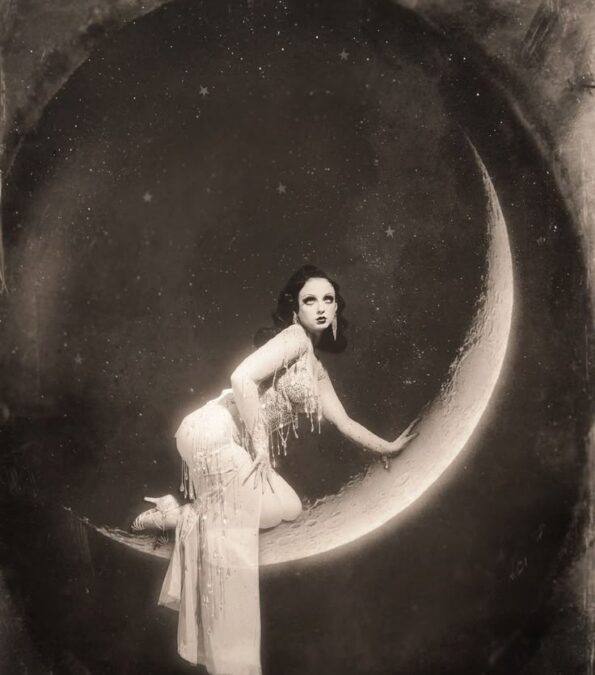
 The Moon part of us remembers before we know we are remembering. It is the quiet archivist of the soul, storing the old emotional fingerprints we leave on every person, place, and experience. It doesn’t operate with the tidy logic of the conscious mind. It represents the emotional habits we inherited, absorbed, or built for survival. To understand this body is to follow the emotional thread backward, often all the way to childhood, where the first language of safety, love, hunger, guilt, comfort, and fear was learned. Before we had theories about ourselves, we had atmospheres. The Moon absorbs all of this. It remembers what the conscious mind politely edits out. And yet it also shows the places where we may still be reacting to the past as if it is happening right now. There is great beauty in the Moon because it reveals how deeply human we are. It is where we know things in the body before the mind catches up, where we recognize familiar sorrow in another person’s eyes, where we carry lullabies, grief, family recipes, old wounds, and strange little preferences. The Moon part of us can nurture, attach, remember, and belong.
But the difficulty of the Moon is this: it can make us loyal to what is familiar, even when what is familiar is no good for us. The subconscious says, “Yes, this pain. I know this pain. Pull up a chair.” It is often why people repeat emotional patterns they swear they are done with. They are being pulled by an inner gravity formed long before they had the power to choose differently. The Moon is this gravity. The deeper work of the Moon is to bring its patterns into consciousness with compassion and a little bit of backbone. We begin to notice when an old feeling is driving the car while the adult self is locked in the trunk asking reasonable questions. We begin to ask whether our reactions belong to the present moment or to some ancient emotional feeling still affecting us from 1997.
The Moon is an endless emotional well within us, and most of the time we do not notice how deep it goes until something drops into it. So much of what we do in the present is quietly guided by feelings we haven’t fully named. We may believe we are making rational choices, and sometimes we are. But often, beneath the clean surface of logic, an ancient emotional current is steering the boat. We choose certain people, avoid certain conversations, crave certain comforts, repeat certain dramas. Something inside us recognizes a familiar emotional climate. The Moon has a strange loyalty to what it knows. It can mistake familiarity for safety, even when familiarity is just an old wound.
The more unconscious we are of these feelings, the more vulnerable we become when they suddenly rise to the surface. And they do rise. Usually at awkward times. One moment we are fine, adult, composed, answering calls and pretending to be a functional citizen. The next moment, a tone of voice, a delay in response, a certain look in someone’s eyes, or the smallest hint of rejection opens a trapdoor beneath us. Suddenly we are no longer only reacting to what is happening now. We are feeling everything it reminds us of.
It is the strange power of the Moon. It folds time. A present emotion becomes a doorway into an earlier emotional world. We may feel abandoned, ashamed, unwanted, guilty, exposed, or furious with an intensity that seems larger than the moment itself. And that is because it usually is. The feeling has roots. It comes carrying luggage. It has traveled from childhood, from family atmospheres, from old disappointments, from the times we had to swallow our needs or exaggerate them just to be noticed. When the Moon is stirred, the past doesn’t stay in the past.
We can’t take this to mean our emotions are irrational nonsense. It would be the lazy interpretation, and frankly, the psyche deserves better gossip. Emotions have intelligence, but they speak in symbols, moods, and sudden storms. They tell us where we have been hurt, what we still need, what we fear losing, and what we secretly long to receive. But we often do not know what our feelings are actually about. So we attach an old hurt to a new person, a childhood fear to a current disagreement, an ancient hunger to one unanswered message. Then we wonder why something small feels enormous.
Beneath every sudden emotional surge is a part of us trying to be understood. Even anger. Hurt. Fear. Need. Shame. Longing. The Moon contains all the feelings we learned to hide, manage, dress up, deny, or turn into personality traits. It is where the child within us still waits to see whether love will stay, whether comfort will come, whether it is safe to need, safe to cry, safe to be human. When we are unconscious of the Moon, we are often ruled by it. We call it instinct, chemistry, mood, intuition, or “just the way I am,” which is a phrase people use when they are about three inches away from discovering something uncomfortable. But when we begin to understand our lunar nature, we start noticing the emotional pattern beneath the reaction. We pause and ask, “Is this about now, or is now touching something from then?” This question alone can change a life. It creates a little space between the wound and the response, between the old story and the new choice.
To become conscious of the Moon is to stop being ambushed by our own depths. The feelings may still come, but they no longer have to drag us backward by the ankles. We can meet them with curiosity instead of panic, love instead of shame, humor instead of self-crucifixion. We can say, “There you are again.” The old feeling is a messenger from a younger self who didn’t yet have the words, the power, or the safety to understand what was happening.
The Moon represents the inner nature, the feeling realm, the unconscious, and instinctive reactions. …The Moon also stands or the ability to establish contact, the longing for closeness and security, the home, way of life, attachment to home, memories, and the need for emotional security. Key Words for Astrology

The Moon carries something ancient in us, something with fur, teeth, hunger, memory, and an extremely low tolerance for being cornered. It belongs to the body, to instinct, to the pulse beneath the skin. It knows when a room feels wrong, when a person’s kindness has a hook in it, when silence has changed shape, when danger is present. It is so difficult to tame. It doesn’t respond well to lectures from the rational mind. You can tell yourself to calm down, be reasonable, stop overreacting, and behave like a well-adjusted mammal, but when instinct takes over, the body becomes louder than thought. The heart pounds, the stomach tightens, the voice sharpens, the old defenses rise like wolves from the treeline. Something primal steps forward and says, “I have handled this before. Move aside.” And often, what it has handled before is every danger that ever taught it to be watchful.
The image of the wolf belongs here. The wolf is loyal, alert, communal, territorial, intelligent, and sensitive to threat. It knows the language of scent, sound, distance, and night. Sometimes survival growls. Sometimes it bares its teeth. Sometimes it howls because the feeling is too large to fit inside the body quietly. Beneath the Full Moon, when emotions are heightened and the inner tides rise, the wolf in us becomes visible.
The Moon, in this sense, reveals the animal truth beneath the civilized costume. Most of the time, we imagine ourselves as rational beings occasionally interrupted by emotion. But we are emotional creatures who learned how to speak. Our instincts are underneath us, holding up the floor. They are the old intelligence of the body, the inheritance of every ancestor who survived long enough to become someone’s complicated family pattern. When we feel threatened, this lunar nature can become volatile. The savage quality of emotion is often the panic of vulnerability in armor. We lash out when something tender has sensed danger and sent the nearest available beast to stand guard. Anger is often grief with its boots on. Defensiveness is often fear wearing a cheap leather jacket and pretending not to care.
This is the difficult beauty of the Moon. It illuminates what we cannot easily explain. Unnamed dread, strange premonitions, gut feelings, inexplicable waves of sadness, sudden certainty, irrational unease, the sense something is coming or something is wrong. These experiences can make us feel unsteady. The Moon governs this dim, silvery territory where the unconscious speaks through feeling rather than language. It gives chills. It gives dreams. It gives a tightening in the chest, a pull in the belly, a mood appearing from nowhere and yet feels older than the day itself.
For centuries, humanity has looked at the Moon and seen beauty, but also disturbance. Its changes seemed to mirror our own fluctuations, the way we swell, empty, brighten, disappear, return. Its association with lunacy was never only about madness in the crude sense. It was also about anxiety, unrest, the sense human beings aren’t as firmly in control of themselves as they would like to believe. The Moon has always been a shimmering insult to our fantasies of composure. It says, “You are tidal. You are cyclical. You are water in a skin suit, doing your best.”
The Moon is associated with the mother-goddess. It is maternal, but not in the sanitized way where motherhood smells like fresh linen and everyone has processed their trauma. She is the older mother, the dark mother, the protector of birth, blood, hunger, sleep, fear, attachment, and the cries that come before language. She rules the places where we are most dependent, most needy, most porous, and most afraid of being abandoned in the cold. Her tenderness is immense, but it isn’t always soft. Sometimes it is fierce enough to frighten even the one being protected. The mother animal doesn’t ask for consensus before defending her young. She moves.
Within us, this lunar mother watches over the vulnerable inner creature. The problem is that she can mistake discomfort for danger, intimacy for invasion, uncertainty for abandonment, and criticism for exile. Then the emotional response becomes larger than the situation, because it is responding to every similar moment. The Moon cannot experience time neatly. It stacks feelings. A small slight can awaken an old wound. Suddenly the wolf is awake, and the poor person across from us has no idea they have just stepped on a landmine buried in the past. Yet these instincts are messengers from the deep body. They show us where we have learned to survive, where we still feel unsafe. To dismiss them as irrational is to miss their intelligence. To obey them blindly is to become their hostage. The work is not to kill the wolf, tame it into a golden retriever, or make it wear a little emotional-support vest and pretend everything is fine. The work is to learn its language. To understand when it is warning us wisely, and when it is reacting from old fear. To respect its power without letting it run the entire village.
The Moon in her ghostly, silver light reveals our fears. She shines on what hides in the inner forest. She makes visible the shapes we sense but cannot name. Under her glow, the rational mind loses some of its authority, and the buried self begins to stir. This can feel frightening because we prefer our fears neatly labeled, alphabetized, and stored somewhere behind the personality. But deep fear rarely behaves this way. It comes as a shadow, a dream, a mood, a sudden knowing.
At its most difficult, this lunar wildness can make us reactive, suspicious, moody, defensive, and emotionally dramatic. But at its most beautiful, it gives us instinctive wisdom, fierce loyalty, and the courage to feel what civilized life often asks us to bury. It reconnects us with the creature-self, the body-self, the ancestral self. The self who knows how to protect, bond, grieve, desire, and survive. There is dignity in this wildness. There is intelligence in the howl. We are living beings with tides, cycles, claws, softness, memory, and moods. We contain the infant and the animal, the mother and the wolf, the frightened child and the ancient guardian. To know this part of ourselves is to become more honestly human. When the wolf howls beneath the Full Moon, we shouldn’t automatically fear it, shame it, or let it devour the place. We listen. We ask what it knows. We ask what it is protecting.
The Moon remembers everything in the deep, bodily way a house remembers every storm it has survived. She holds the emotional residue of our lives in a vast inner container: every comfort, every shock, every disappointment swallowed too quickly, every longing we dressed up as indifference because needing things felt embarrassingly dangerous. Nothing is lost in the Moon. It may be buried, softened, distorted, disguised, or shoved behind some impressive adult coping mechanism and a drinking problem, but it is not gone. The Moon is a powerful symbol for the unconscious self. She receives. She absorbs. She stores. She becomes the inner vessel where our experiences settle. As human beings, we do not move through life neutrally. We respond to everything.
Some people learn early to shut the doors quickly. They become experts at emotional lockdown. The feeling rises, and before it can embarrass anyone by becoming visible, the gates slam shut. They intellectualize. They joke. They go cold. They become very busy. They suddenly need to reorganize the kitchen, become “fine,” or develop a passionate opinion about something completely unrelated. This shutting down is often it is old self-protection. It says, “We won’t be hurt again. We will not need too much. We will not be caught wanting.” And for a while, it works. The person looks composed. Functional. Reasonable. But the Moon does not disappear simply because we refuse to look at her. Feelings move underground. The unconscious becomes crowded with anxieties, repressions, complexes, fears, and half-formed griefs that have never been given a proper chair at the table.
They begin to influence us from below awareness. We may not know why we distrust kindness, why we panic when someone gets too close, why criticism feels like annihilation, why silence feels like punishment, why we crave reassurance and then resent needing it. The unconscious leaks. It slips into our reactions, our attractions, our dreams, our defensive little habits, and the arguments we keep having with different people under the same emotional sky.
We cannot hold the unconscious firmly in our hands, these feelings often surface at the worst possible moments. The psyche rarely waits for a convenient opening in the calendar. It erupts during a conversation that was supposed to be simple. It appears in the middle of love. It ambushes us while driving, working, parenting, flirting, apologizing, or trying to be the sort of person who has “done the work.” A small event happens, and suddenly the emotional response is enormous. We are flooded.
Sometimes we take a feeling from long ago and cast it onto the person standing in front of us now. A partner’s tiredness becomes rejection. A friend’s delay becomes proof of not mattering. A boss’s feedback becomes a childhood tribunal. Someone’s harmless tone becomes the sound of a parent, an ex, a wound, a room where we once felt small. The reaction may seem excessive, but beneath it is an emotional logic. The response is about what has happened before, and what the body fears is happening again. The Moon doesn’t say, “This situation resembles an earlier emotional pattern.” She says, “Danger. Same feeling. Do something.”
When life becomes emotionally difficult, we are often being called back to this lunar self. Different traditions name this lunar force in different ways. Some see it as the soul, the soft and ancient essence carrying memory across time. Others call it the ego, the familiar self built from attachment, habit, need, and emotional identification. Psychologically, it can be understood as the unconscious self, the hidden interior shaping our reactions. These names may differ, but they circle the same mystery: the Moon is who we are underneath. She is the inner life beneath the biography, the feeling-pattern beneath the personality, the private mood behind the face we show the world.
She shapes us constantly. Like the tides, she stirs us rhythmically, invisibly, faithfully. We like to imagine identity as something solid, something built from decisions and values and carefully chosen opinions. But beneath that, we are also being moved by emotional tides that rise and fall through the day, through relationships, through memory, through the body itself.
To know the Moon is to become more merciful toward ourselves without letting ourselves off the hook entirely. It is to say, “Yes, this reaction has a history,” and also, “No, I do not need to throw the crockery because of it.” It is to honor the child, the animal, the soul, the unconscious, the vulnerable creature inside, while still asking the adult self to stay present and drive the car. She remembers everything because some part of us must. And slowly, as we learn her rhythms, we discover a renewed sense of emotional security. It is the ability to sit beside our own inner waters and say, with tenderness, humor, and a little hard-earned nerve, “I know what this is. I know where it comes from. And this time, I can choose what happens next.”