 Narcolepsy is a thief of consciousness, it comes in uninvited, sapping vitality and leaving bewilderment in its wake. One might expect a prominent Neptune, the elusive dreamer, perhaps tangled with the Moon or Mercury. Neptune, the planetary patron of dreams, illusions, and altered states, when overly influential, might suggest a psyche prone to drifting beyond the veil of consciousness even when wide-eyed and ostensibly awake. And what of Pisces, ruled by this same Neptune? A heavy Piscean influence can make one sensitive, tuned in to realms beyond the mundane, but such porous psychic boundaries might also render one vulnerable to the capricious grip of sleep disorders, spiritual visions, and, even hallucinations that blur the line between dream and reality.
In medical astrology, the 12th House is a shadowy dominion. It governs the subconscious, dreams, and hidden afflictions—an appropriate residence for our mysterious condition. A packed or afflicted 12th House, with any powerful planet, could indicate sleep disturbances or chronic fatigue. Could the soul, weary from partaking in the waking world, be yearning for retreat, for integration, for dreamtime revelations?
To fall asleep against your will, to slip beyond the veil while the world continues on around you, this is no ordinary malady. It’s a rupture in the rhythm of life, as though time itself falters and forgets how to behave around you. Now, imagine for a moment that such an experience has its mirror in the stars. In narcolepsy, the neurological gateways that normally separate sleep from wakefulness malfunction. Dreams invade the daylight, the body collapses into stillness even as the mind remains aware. One might be trapped in sleep paralysis, the harrowing moments when the eyes open but the limbs refuse to move. In the chart, such an experience might reflect a troubled Twelfth House—the realm of dreams, secrets, and that which we cannot quite name. This is where we hide things, or rather, where things hide from us. It’s the house of retreat and refuge, of prisons and madhouses, and it often speaks to the parts of our lives that feel fated or overwhelming. If this house is heavy with planetary occupants or shadowed by Neptune, it may describe a life that is drawn again and again into the mysteries of sleep, solitude, and surrender. And surrender is the crux of the matter. You are called—sometimes forcefully, rudely—to let go. The body refuses to participate in the performative frenzy of modern life and demands instead a pause.
When we speak of narcolepsy, it is a condition that blurs reality, disorients time, and muddles the line between dreaming and waking. The 12th house, when challenged, it can signal disruptions in the way the self interacts with reality itself. The 6th house, standing opposite, demands routine, health, and order, it wants timetables and appointments, regular meals and functioning organs. But when this axis is disturbed, the routine collapses. Mercury, messenger of the gods, governs cognition, perception, and communication—but when Mercury is compromised, especially by Neptune or Uranus, the messages become garbled. Mercury afflicted might mean the signals from brain to body don’t arrive on time, or arrive too soon, or are laced with symbols instead of instructions.
The mind becomes a trickster playground—moments of lucidity followed by blankness, flashes of insight amid fugue states. One moment, you’re taking notes in class; the next, you’re in a dreamscape, having conversations with people who aren’t really there. Uranus rules the brain’s electrical functions, the sudden spark of intuition, but also the chaotic misfires. When Uranus is implicated, especially if it’s sending hard aspects to Mercury or the Moon, we might see neurological anomalies, a brain that doesn’t conform to conventional wiring. It might be brilliant, erratic, visionary, but it’s not easy to live with.
The nervous system is a spiritual antenna, a receiver of the invisible, the ineffable. And when the signals go awry, when the circuitry sparks and splutters under the weight of voltage, the entire self goes haywire. It’s no coincidence that Uranus, named after the primordial sky god, is associated with sudden insights, genius, and revolution. In the chart, a strong Uranian influence suggests someone who thinks differently, but it also suggests someone whose very being is wired to intercept transmissions from a realm outside of ordinary consciousness.
Now, this may sound romantic—visionaries, prophets, innovators—but there’s a cost. Just as lightning both illuminates and destroys, Uranian energy does not lend itself to balance. When unbalanced, it fries the circuits. The individual may find themselves unable to rest, thoughts racing like wildfire. Sleep becomes harder, the mind too loud, too alive. The body, attempting to house this electrical storm, begins to falter. Muscles twitch, digestion stumbles, the heart thuds unexpectedly. The physical form, so gloriously earthy and slow, struggles to keep pace with the speed of thought.
And therein often lies a breakdown. The nervous system, the vital bridge between mind and matter, becomes overloaded. Something’s going to give. The result? Exhaustion, irritability, sensory overload. For some, this might appear as anxiety or insomnia. For others, in more extreme expressions—especially when compounded by other planetary factors—it can manifest as conditions like narcolepsy, seizures, or psychosomatic disorders. The body becomes the site of rebellion, the place where too much spirit, too much signal, bursts through the skin.
These individuals may oscillate between brilliance and breakdown. They see patterns others miss, feel truths that are yet to be spoken. But they can also be impulsive, erratic, even volatile, throwing people off, destabilizing relationships, or turning inward with a sense of alienation.. Those marked by Uranus are not meant to conform—they are meant to awaken. But awakening, let’s be honest, is often a messy business. It happens through sleepless nights, shattered illusions, and sudden downloads of data that don’t fit into neat, socially acceptable boxes.
Uranus in the 6th House
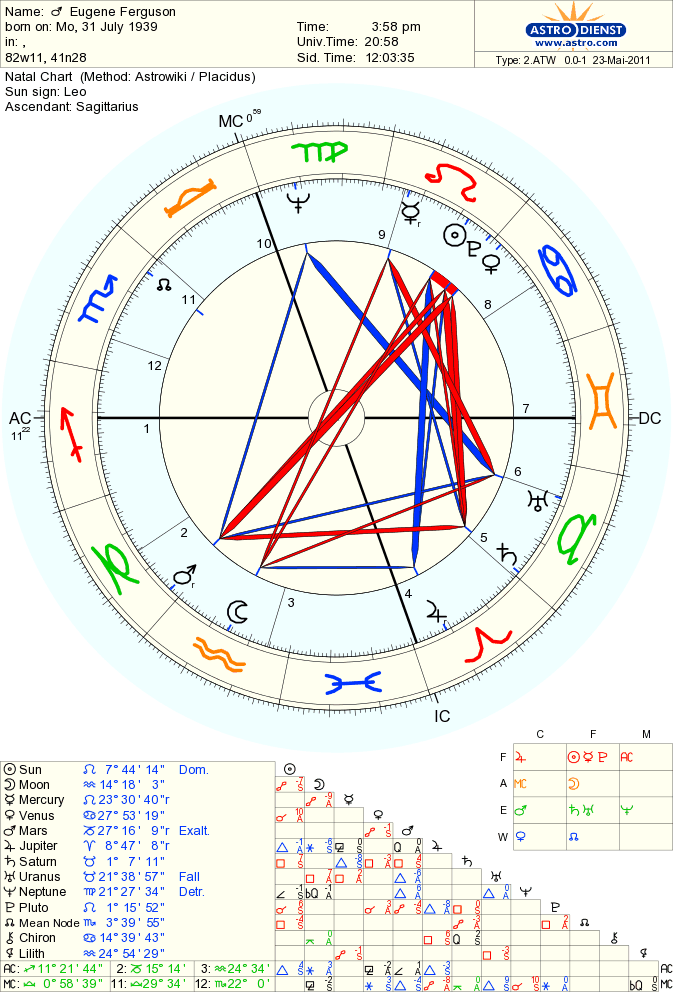 Individuals infused with potent Uranian energy often move through the world like walking voltage spikes. Their presence seems to distort the field around them. Computers freeze. Phones glitch. Watches stop ticking. The very being disrupts the predictable march of matter, tugging at the seams of the fabric that holds reality’s routines together. There’s a strange sort of power in that, a chaos that defies logic yet feels utterly real to those who live it. And why wouldn’t it be? Uranus doesn’t obey the rules of linearity or decorum. It arrives like a divine spark—unexpected, uninvited, transformative. Now, when this frenetic energy gets trapped, when it has nowhere to go, it doesn’t simply disappear—it turns inward. And in the case of the narcoleptic individual, this is precisely what seems to have occurred. The chart to the right helps identify the different aspects a person with narcolepsy might experience. His body, rather than disrupting the devices around him, became the very system that short-circuited. Like a computer pushed beyond its limits, he would shut down, mid-program, mid-lecture, mid-sentence. Not gently, but instantly. Not from fatigue in the conventional sense, but from an energetic overload, neurons refusing to play nice, a brain too full, too fast.
The Moon in opposition to Mercury—already a psychic tug-of-war. The Moon, ruler of the emotional body and unconscious rhythms, craves continuity, comfort, a gentle ebb and flow like the tide. Mercury demands stimulation, logic, quickness. When these two are at odds, the psyche becomes a site of contradiction: thoughts that race while feelings resist, emotions that surge without explanation, an inner dialogue in a constant state of conflict. Rest becomes elusive, because rest requires coherence. And in this chart, coherence is under siege.
Now add Uranus to the mix—on the cusp of the 6th house, the very house of bodily habits, daily rituals, and health. Uranus doesn’t respect boundaries; he blasts through them. Here, he doesn’t merely disrupt sleep, he rewires the very foundation of how this person experiences the body. Uranus on the 6th house cusp, effects daily life: erratic energy levels, unpredictable physical reactions, a body that doesn’t keep regular hours but instead follows its own, often inconvenient, rhythm.
Forming a T-square with the Moon and Mercury, Uranus becomes the focal point, the pressure valve. The tension between thought (Mercury) and emotion (Moon) must be resolved through Uranian upheaval: insight, revolution, or breakdown. In the context of narcolepsy, this translates beautifully (though painfully): a mind flooded with too much input, an emotional system overwhelmed by too much sensitivity, and a body forced into involuntary shutdowns as a coping mechanism.
And consider his relationship to the 12th house—the house of dreams, sleep, and hidden ailments. Uranus opposing the cusp of the 12th is disruption—it demands it. The subconscious is on high alert, invaded by chaotic energies. Nocturnal sleep becomes fragmented, haunted by flashes of insight, jolts of fear, or surreal visions. The dreamworld, meant to soothe and integrate, becomes another battleground. Meanwhile, in the daylight hours, when the world expects alertness and participation, the body betrays those demands and slips into unconsciousness. It’s as though his internal clock has been rewired by Uranus himself, set to a frequency beyond the reach of ordinary time..
The 6th house is where order lives, where we attempt to impose some form upon the shapelessness of time. It governs our job roles, our health regimens, our skills and service—the dull but dependable beat of the daily drum. When Uranus resides here, the individual becomes almost allergic to repetition. The idea of clocking in and out, of plodding through the same motions day after day, feels like an itch they can’t quite scratch. Conformity, to them, isn’t security, it’s suffocation. They need variation, stimulation, the electric charge of the new. This doesn’t mean they’re lazy or unreliable, far from it. In the right setting, they can be innovators, visionaries, disruptive geniuses who push boundaries in science, tech, medicine, or any field where old models are crumbling and new paradigms are itching to be born.
They’re not content with the “because it’s always been done this way” logic. They want evolution, progress, freedom to experiment, even if it means upsetting a few apple carts along the way. But this placement is double-edged. If Uranus in the 6th is challenged—especially by hard aspects, it doesn’t just suggest brilliance; it also speaks of instability. The daily grind becomes an obstacle course. Jobs may be started and abandoned. Colleagues may find them unpredictable. Sleep schedules, eating habits, work routines—all subject to spontaneous overhaul. Health, too, may reflect this erratic rhythm: sudden, unexplained ailments, nervous tension, conditions that appear and vanish with little warning. The very nervous system becomes the bellwether for imbalance.
Uranus here acts meddles with the internal clock. The daily rituals, the humble acts of waking, working, eating, resting—become fragmented, unstable, unreliable. It’s a deeper, more unsettling disorder. The body is dancing to a rhythm only it can hear, a rhythm that ignores social convention and biological regularity alike. From a health perspective, this planetary position often coincides with conditions that defy classification. The symptoms are real, often severe, yet they flicker and shift like shadows in a storm. One moment, the body seems to function; the next, it collapses. Eugene’s narcolepsy—sudden, unpredictable, and jarringly disruptive—is a textbook manifestation of this Uranian meddling. Doctors may frown, scratch their heads, run tests that yield nothing but more questions.
What’s especially poignant here is how Uranus on the 6th cusp challenges our assumptions about stability. We assume that health means predictability, that the body will rise with the sun and wind down with the moon. But for this man with narcolepsy, this expectation is a luxury he cannot afford. His sleep, the most basic necessity, is governed by an internal function completely misaligned with earthly rhythms. And this misalignment is isolating. It creates a profound disconnect from societal norms, from the comforting structure of a shared timetable.
And yet, there’s also an invitation in this. To realize that what we call “normal” is not universal. The routines we rely upon are, in fact, gifts—fragile, precious, and easily disrupted. His experience calls us to humility. To gratitude. To the realization that consistency is not a guarantee. So we return to Uranus—rule-breaker, divine provocateur—who, in the 6th house, tears down the illusion of control. For Eugene, and for all who walk the path of erratic embodiment, there is hardship, but also a kind of initiation. An entry into a deeper understanding of what it means to be human, and how much grace is needed just to sleep through the night.