 Another Earth is an unsettling film about a parallel universe. It quietly pries open something deeply human and deeply uncomfortable. The film gives this almost impossible image to sit with: another planet appears in the sky, identical to Earth, inhabited by people who are identical to the ones here. And suddenly the idea is no longer abstract or astronomical. It becomes personal in the most unnerving way possible. Because another Earth means another you. Another version of your life. Another set of choices. Another fate unfolding under a different arrangement of chance, pain, courage, and timing. This kind of idea makes you think. It is really where the power of the film lives. It is famously quiet, slow, even awkwardly still at times, with long silences and no comforting soundtrack to tell you what to feel. It can feel plodding, even frustrating. But this slowness is part of what gives it its strange emotional gravity. It leaves you alone with the idea. It doesn’t distract you from its implications with noise and cleverness. It just places this impossible mirror in the sky and lets your mind do the dangerous work. And the dangerous work, of course, is wondering what it would mean if somewhere out there existed a person with your face, your history, your wounds, and yet perhaps a completely different life.
It forces you to confront how much of who you are feels essential, and how much may just be the result of timing, accident, and one or two catastrophic decisions made on the wrong day in the wrong state of mind. The existence of another Earth suggests your life, which feels so singular and intimate from the inside, might actually be only one version among many. This thought is both thrilling and slightly insulting. You spend your whole life assembling an identity, and then the universe comes along and says, actually, there may be another one just like it nearby. It destabilizes the ego in the most elegant way. It asks whether you are truly a fixed self, or just one draft among several, one possible arrangement of the same human material.
Of course, once the film opens this door, regret comes storming in like it has been waiting years for this exact moment. Because the idea of another you isn’t neutral. It immediately becomes emotional. You begin to imagine that on this other Earth, another version of you may have chosen better, loved more wisely, spoken more honestly, or avoided the mistake that split your life into a before and after. This is what makes the premise so provocative. It gives shape to the oldest ache in human psychology: the ache of the unlived life. The suspicion that somewhere, just beyond reach, there is a version of your story in which you did not fail in the same way, didn’t wound the same people, didn’t lose what you lost. Another Earth turns this feeling into something almost visible. It hangs in the sky like a giant, glowing accusation.
But the film is also about your relationship to guilt, longing, and the fantasy of redemption. Because if there is another you out there, then there is also the unbearable thought: some version of you may be freer, cleaner, less burdened by what has happened here. And this can awaken something very painful: the desire to escape your life, but also to meet the self you might have been if suffering had bent you differently. The film understands this is one of your most private forms of grief. Grieving what happened, but also grieving the person you could have become if things had unfolded another way. It is a hard grief to name, because it sounds melodramatic when said aloud, yet privately it is one of the central sorrows of being a person. You don’t only mourn losses. You mourn versions of yourself.
The duplicate planet is a cool concept, but it is also a device for exposing how fragile your sense of self really is. You like to think of your identity as something solid, a finished portrait, but the film suggests it may be more like a reflection on water: recognizable, real enough, and yet always rippling in different directions. Who you are is partly character, but also circumstance, timing, damage, luck, and the strange little choices that seem insignificant until they alter everything. Such a realization can be terrifying, because it means you are less in control than you hoped. But it can also be strangely merciful, because it means the self you judge so harshly isn’t some pure moral essence. It is a human being formed in motion, under pressure, in confusion, doing the best and worst things at once.
The film lingers with the idea of reality containing parallel possibilities, and in doing so, it quietly asks whether you can bear to look at your own life without flinching. Another Earth is provocative because it turns a mystery into an intimate one. It is not really asking, “What else is out there?” It is asking, “Who are you, really, when stripped of the story you have told yourself about inevitability?” It invites you to imagine another self so that you can better understand how contingent, vulnerable, and strangely precious this one life is. It offers no neat emotional anesthesia, no triumphant orchestral swell to reassure you that everything means exactly what it should.
In Penny Thornton’s The Forces of Destiny, the same current appears again in a completely different context, this time through reincarnation and the idea of “repetition in eternity.” It is metaphysical reflection, asking whether life is repeated, or reconfigured across some larger pattern of existence. In Another Earth, this takes the form of another world containing another you, which immediately awakens all the old human obsessions with regret, fate, and the unlived life. In Thornton’s discussion of repetition in eternity, the question shifts from “Could there be another version of me somewhere else?” to “Am I, in some deeper sense, moving through recurring patterns of selfhood, consequence, and unfinished emotional business?” And this is where things get psychologically interesting, because the real sting in both ideas is accountability. It brings the suspicion that the things you avoid, repeat, damage, desire, or fail to understand don’t simply vanish because time moves on. They may return in another form, another life, another version of reality.
The thought of repetition in eternity carries both comfort and dread. Comfort, because it suggests your life is woven into something larger than random chaos, and your struggles may belong to a meaningful design rather than being just an unfortunate pileup of accidents. Dread, because it also suggests nothing is so easily escaped. The unresolved parts of you, the wounds you keep dressing up as personality, the choices you keep calling “just how things went,” may not be finished with you simply because you are tired of them. They may come around again.
Repetition in eternity is the possibility the soul, or the psyche if you want to keep your shoes firmly on the ground, keeps circling the same central conflicts until something is genuinely understood? Deeply, painfully, transformatively understood. In this sense, repetition is revelation. It exposes where you are divided against yourself. It reveals the places where your desires and fears keep dancing the same exhausted dance. You think you are choosing freely, and often you are, but you are also choosing from within patterns you barely notice until life presents them again in a different mask.
Another Earth externalizes this mystery by giving you another physical world, another self, another possible life. Thornton’s idea of repetition in eternity internalizes it, suggesting the “other you” needn’t exist on a planet in the sky at all. It may already exist within the repeating lives of your own becoming. One version of you makes the mistake. Another version revisits its consequence. Another version longs to repair it. Another version finally sees the pattern for what it is. Suddenly the sci-fi premise and the reincarnation theme start holding hands in the dark. Both are asking whether the self is a fixed object or a recurring process, whether your life is a single line or a spiral, whether what feels like coincidence may actually be recurrence. What part of your story feels as though it is forever trying to complete itself? If repetition exists, whether metaphysically or psychologically, then you aren’t doomed to just repeat; you are also repeatedly invited to become conscious. The pattern returns because some part of you still wants freedom badly enough to keep trying. It is the beautiful difficulty of it. Eternity, in this sense, is more than just endlessness. It is intimacy with what you cannot outrun.
“As Tadd Mann puts it in the Divine Plot, Eudemus ‘identified two kinds of recurrence: one is “repetition in time” of the natural order of things such as the seasons, day and night, produced by cycles of the sun, moon, earth and the planets; the second is “repetition in eternity” in which identical things exist in a number of existences.’
The sky is a correspondence. A symbolic picture of the inner life of human beings in patterned, cyclical, strangely timed ways to dismiss it as as random. As above, so below is a governing intuition. It names the deep, almost bone-level sense of the movements above and the movements within belonging to the same conversation, even if the language remains partly veiled. The universe is both beautiful and maddening: it offers meaning, but never in a form tidy enough to stop the questions. It is how you stand in a particularly human place where wonder and frustration make a home together. On one hand, you can feel the undeniable rhythm of cycles, transits, returns, patterns repeating themselves through time. You see the way life does not move in a straight line so much as in spirals, with themes resurfacing, lessons ripening, old material returning. The heavens seem to mirror this, or perhaps participate in it. But on the other hand, the universe remains infuriatingly unwilling to show its full hand. It keeps giving you symbols rather than certainties. So you are left sensing connection everywhere, while still having to live with mystery.
Parallel universes feels so compelling in this context. It is more than a scientific curiosity to ponder while you drink your wine. It speaks to something psychologically and spiritually intimate. Parallel realities suggests life may be far more layered than the ordinary mind can comfortably tolerate. That there may be multiple expressions of self, multiple threads of fate, multiple versions of becoming, all unfolding beyond the neat little fence line of rational certainty. It gives symbolic shape to an experience you probably already know inwardly: existence often feels larger than literal events. Sometimes a choice carries the weight of several lives. Sometimes a relationship feels ancient before it has even become familiar. Sometimes grief, longing, or déjà vu arrive with the odd authority of something not entirely confined to this moment alone.
Alison Chester Lambert assigned Pluto to this territory, because Pluto governs what lies beneath the visible order of things. It rules the underworld of the psyche, the buried strata, the hidden forces, the transformations dismantling your tidy little self-concepts. Pluto is where life becomes subterranean, where the obvious story breaks down and something deeper, stranger, and less controllable begins to move. Pluto points to concealed, potent, and not easily accessed dimensions by ordinary consciousness. It exposes. It drags material up from the depths. If parallel realities belong anywhere astrologically, Pluto is certainly one of the first places the mind would go, because Pluto rules the unseen realm of power, death, rebirth, and the invisible continuities binding one state of existence to another.
But it could still be something else. This subject is too large to be locked neatly inside one planetary symbol. Pluto may describe the hidden realm itself, the underworld quality of alternate dimensions and unseen realities, but the experience of encountering such possibilities could also belong to other principles. Mercury, for instance, it has a knack for correspondence, crossings, thresholds, and meaningful linkage. Mercury is the messenger, the connector, the trickster who makes one thing suddenly reflect another. If Pluto is the abyss, Mercury is the bridge between worlds, the sly little go-between passing notes from one dimension of meaning to another.
Neptune, too, cannot be ignored, because Neptune dissolves the hard edges keeping one realm separate from another. It governs the oceanic, the imaginal, the transcendent, the states in which boundaries weaken and ordinary distinctions become porous. If Pluto suggests hidden dimensions and Mercury suggests crossings between them, Neptune suggests the great blur in which all separate realities may ultimately bleed into one another. Neptune is where the self becomes less fixed, where time becomes less linear, where the rational mind starts sweating nervously because the walls are no longer holding. There is something deeply Neptunian in the way reality exceeds its visible form. And then there is Uranus, which would be difficult to leave out if we are thinking in terms of quantum leaps, alternate realities, or radical disruptions to accepted models of existence. Uranus rules rupture, revelation, the sudden crackle of insight as it breaks open old frameworks and introduces a reality too strange to have been predicted by common sense.
Where Pluto buries and intensifies, Uranus electrifies and liberates. Parallel universes as a concept have a distinctly Uranian flavor in the sense they challenge consensus reality and force the mind to reckon with a far more complex cosmos than it had arranged. Uranus is the cosmic equivalent of someone yanking open the curtains and saying, “You do realize this is much bigger and weirder than your current theory allows, yes?”
No single symbol may contain parallel universes this completely. Pluto may rule the hidden realm, Uranus the breakthrough into new models of reality, Neptune the dissolution of boundaries between planes of existence, and Mercury the uncanny correspondences through which such mysteries make themselves known. In other words, reality itself may be too multidimensional for a one answer. Psychologically, this matters. Because what draws us to these questions is a hunger to understand how deeply our lives are embedded in something larger. We are trying to make sense of the tension between fate and freedom, repetition and evolution, personal suffering and cosmic order. We want the universe to be meaningful, but we are perceptive enough to know that meaning doesn’t come cheaply. It asks us to tolerate ambiguity. It asks us to live without final proof while still honoring the patterns we see. It is a difficult calling, because it means existing in a state of disciplined wonder rather than dogmatic conclusion.
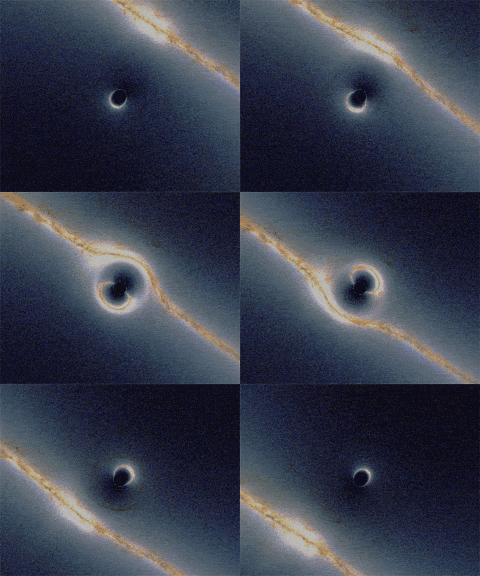
Pluto seems to drag us toward the edge. Pluto is never content with the surface of things. It wants the basement, the graveyard, the locked room, the psychic underworld where endings ferment into beginnings and where the neat little stories we tell ourselves about control go to die in dramatic fashion. Pluto is linked with black holes, and all those other cosmic doors marked abandon certainty, all ye who enter here. Pluto has this quality. It feels like being pulled toward something so dense, so absolute, our usual coordinates fail. And anyone who has lived through a true Pluto transit knows it rarely feels like a charming growth experience. It feels more like being swallowed whole by a question we cannot answer and a transformation we didn’t volunteer for.
Pluto so often feels like an abyss. It is total. Under its influence, we don’t just feel sad, or uncertain, or bruised. We feel dismantled. We feel as though some invisible force has reached into life and removed the reassuring parts, leaving us staring into a void where our old identity used to be. It is a psychic demolition while we try to understand why the sky is suddenly inside the house. It belongs so naturally to symbols like black holes and the unknown pockets of time. It describes those experiences in which we are taken beyond the familiar frame of reality and forced into contact with something deeper, stranger, and more absolute than our everyday self can comfortably bear.
Pluto has connection with zero. Zero carries the same paradoxical quality Pluto does. It is emptiness, yet it alters everything it touches. It is nothing, yet without it whole systems of meaning collapse. It is absence with enormous consequence. Psychologically, it is very Plutonian. Pluto often works through what has been stripped away, what has been lost, what no longer exists in the form you depended on. It introduces you to the power of vacancy. To the violence of the empty space. When something dies in your life under Pluto, whether it is a relationship, an illusion, a role, a certainty, or a whole version of yourself, what remains at first can feel like zero in the bleakest sense: blank, annihilated, hollowed out. But this emptiness is charged. It is the dark soil before germination, the silence before a truth becomes audible, the strange in-between where one is no longer who one was but not yet anyone recognizable. Zero is the womb wearing funeral clothes.
Zero and infinity have this maddening habit of meeting at the edge of comprehension. And Pluto lives there, at the threshold where death and rebirth stop being opposites and start looking like accomplices. Life doesn’t move in clean lines. It loops, collapses, renews, devours, regenerates. Endings are beginnings in disguise, and beginnings are often just endings with better lighting. Pluto understands the way death of the old is an interval, a suspended state in which you are asked to survive uncertainty without rushing to replace it with something prettier. This space in-between is one of the hardest places for a human being to tolerate. You want answers, identity, forward motion, a sign from the heavens, a decent cup of tea, something. Pluto offers instead a confrontation with raw process. With becoming. With the fact that transformation is often less like ascending into wisdom and more like being emotionally slow-roasted until the false parts fall off.
This brings us to the oldest questions, the ones beneath all these symbols like a subterranean river: How did it all begin? How will it all end? It can haunt you. It is woven into every loss, every love, every crisis of identity, every moment when something in you ends before something else is ready to begin. Pluto pushes you toward the recognition – every personal ending is a small rehearsal for the great unknown, and every rebirth is a tiny answer to the terror of annihilation.
Black holes, alternate universes, time travel, zero, infinity, death, rebirth, the in-between space, they mirror states of consciousness from the inside. We know what it is to feel pulled into something dense and inescapable. We know what it is to lose our bearings. We know what it is to wonder whether the self we have been living as is only one version among many, or whether some old life in us must collapse for a truer one to emerge.
Is Pluto a planet? Is zero a number? Pluto doesn’t care whether it has been downgraded by committee; it still ruins your illusions on schedule. Zero doesn’t care whether ancient minds trusted it; it still sits there at the center of mathematics like a void. There is something almost comic in it. Humanity loves to classify things, as though pinning a name to the mystery will make it less mysterious. Meanwhile the mystery continues smoking in the alley, unimpressed.
Something can disappear and remain essential. Emptiness can contain possibility. Death can be both ending and threshold. Anyone who loves symbolism can see the beauty in it. What we call the end might actually be a passage, what looks like nothing might be gestating everything, what we call the abyss could be a void or a gate. It is the central drama of being human. Again and again, life takes from us what we thought we were, then demands we keep living long enough to discover what else we might become. In between, we spend our life trying to make friends with symbols big enough to hold what reason alone cannot settle. Pluto is one of those symbols. Zero is one of those symbols. Infinity is one of those symbols. They all speak to the same unnerving mystery: what seems empty may be full, what seems final may be transitional, and what seems like oblivion may be only the point where the visible world hands you back to the invisible one. Which is either profoundly comforting or absolutely horrifying, depending on the day and how well you slept.
Pluto belongs to the category of symbols which are almost too large for language. It resists neat definition. It describes what lies beneath definition itself: the undercurrent, the compulsion, the invisible continuity of the soul, the buried force. It survives endings and uses them as raw material. Pluto is linked to zero, to limitlessness, to death, to reincarnation, to the mysteries of the universe. Some symbols have an interior vastness. Pluto is one of them. It is not simply “intense,” though people love this word because it saves them from having to say anything more. Pluto is primordial. It is the pressure under the floorboards of existence. Zero is one of those strange, elegant paradoxes. It looks empty until you realize it quietly rearranges the entire system. It appears to be nothing, and yet its nothingness is potent. It is absence with consequences. This feels deeply akin to Pluto, whose power so often emerges through what has been stripped away, buried, lost, annihilated, or rendered invisible.
Pluto doesn’t usually announce itself through obvious abundance. It works through vacuum, compulsion, rupture, silence, extinction, the charged emptiness left behind when something false can no longer remain standing. And yet from this emptiness comes creation. It is when illusion dies and something more essential begins to take shape. Zero is a generative void. It is the space before form, the pause before incarnation, the deep inhalation before existence takes on another shape. It feels Plutonian. It is both zero and Pluto. What looks like nothing may contain everything. Pluto has long lent itself so naturally to the language of souls, death, and reincarnation. It rules the dominion of dead souls. It is a ruler of continuities outlasting the visible personality. Pluto governs what is carried beneath the obvious life, what survives the surface drama, what remains unfinished and therefore returns. Jeff Green associates Pluto with the soul’s evolution. It is interested in the deep movement underneath the ego, the ancient material, the unresolved desires and karmic patterns, the buried motives and unfinished lessons pushing a soul toward transformation whether the conscious mind is ready or not.
Pluto when it transits in Aquarius might open up greater knowledge of the universe. It is the hidden depths, the soul, the unseen realms, the underworld of meaning. Aquarius, the future, the collective mind, discovery, breakthrough, radical frameworks, the disruptive expansion of what humanity thinks is possible. Put them together and it is hard not to imagine some deeper probing into realities once considered too strange, too speculative, or too distant for serious attention. Pluto in Aquarius carries the flavor of humanity digging beneath accepted knowledge and discovering reality is weirder, more interconnected, and less flattering to our old certainties than we hoped. Aquarius likes to break the frame. Pluto likes to expose what the frame was hiding.
Existence is far more layered than our ordinary consciousness can comfortably manage. Life may be repeating, branching, and transforming on levels we can sense but not yet fully articulate. All of this speaks to reincarnation, to soul evolution, to parallel possibilities, to the unbearable and beautiful thought that who we are is both deeply real and not the only version of itself. We may be pushed into a deeper encounter with what reality actually is: more hidden, more collective, more evolutionary, more unsettling, and more soul-saturated than the modern ego tends to prefer. When Pluto transits Aquarius, we may learn more about the universe, but in doing so we may also learn more about what a human being is. This is the catch, of course. Every discovery about the cosmos eventually comes home and sits at the kitchen table with us. Another Earth, another realm, another layer of reality, another clue about reincarnation or soul continuity, none of it stays abstract for long. It all turns, eventually, into the same old and ever-new question: what does it mean to exist at all?
Pluto is a confrontation with the unfathomable, with the parts of life we cannot prettify, only endure, enter, and transform through. Zero, eternity, dead souls, soul evolution, hidden worlds, another Earth, these are all attempts to circle the same blazing dark center. Yet, some truths aren’t meant to be pinned down like insects in a display case. They are meant to be approached with the occasional admission that we are dealing with forces much larger than our tidy little conclusions. Which is humbling, but also strangely comforting. It means the mystery is still alive. And so, in some essential way, are we.